Blog

  • Spring has sprunged… er.. springed. Sprung!

    Not that the winter was any great ordeal here, but with the trees in full leaf or nearly so and winter temperatures warm enough to sleep with the windows open, I think we are safe in saying that spring is here. It’s been a busy time here at Oak Hill–especially in getting ready for our first ever spring CSA!

    We have a mostly full garden, with radishes, spinach, potatoes, onions, lettuce, cucumbers, garlic, beets (red and gold), carrots, cantaloupes, assorted herbs, and more. The weeds are hard on the heels of what we planted, and we are working to stay on top of it all. For those in our CSA, our 6-week spring program should begin either the last week of April or the first week of May.

    A large part of the truck patch is full of garlic.

  • Our First CSA!

    It’s almost time! After three years in the making, we’re getting ready to launch our first CSA season at Oak Hill.


    What’s a CSA?

    “CSA” stands for “Community Supported Agriculture.” In the CSA model, individuals or families buy “shares” of the farmer’s crop for the season. Shareholders pay up front, giving the farmer the funds and financial stability to pay for seeds and labor. In return, shareholders get a share of the fresh-picked produce on a weekly basis, depending on what’s ripe for the harvest.


    The Oak Hill CSA, Spring 2012

    Starting on March 15, we’ll be accepting 10 shareholders to purchase a share in our spring CSA. Once a week for six weeks, you’ll receive a 1/2 bushel box full of fresh produce from the farm. In at least three of those boxes, you’ll also get a surprise free gift from us — a dozen farm-fresh eggs, a hand-crocheted vegetable bag, or a jar of jelly, for example.

    Since this is our first year, we’re looking for ten shareholders to act as “guinea pigs,” who are willing to put up with us as we work the kinks out of a brand-new system. In return, we’re offering shares at $96 for 6 weeks of fresh produce. That’s $16 per week — half the price (or less) of most CSAs in the area.

    If all goes well, we plan to offer these veggies in the first six weeks as they come into season:

    • Lettuce (multiple varieties, including butter lettuce and black-seeded Simpson)
    • Swiss chard
    • Parsley
    • Green onions
    • Radishes
    • Spinach
    • Arugula
    • Beets
    • Kale
    • Broccoli
    • Cauliflower

    We’re going to arrange a drop-off location in East Memphis or Collierville within the next couple of weeks. We may bring them to our farmer’s market booth, depending on market restrictions. You can also arrange to pick your box up at the farm. Once we have prospective members lined up, we’ll contact shareholders by email to work out pick-up details.

     
    Risk and Reward in Community Supported Agriculture
    There’s always a risk in buying in to a CSA — but we believe the rewards far outweigh the risks.
    When you buy a share of a CSA, you’re buying more than produce — you’re “sharing” in the fortunes of the farm. We can’t guarantee that a drought won’t kill half our crops, or a late spring frost kill everything we’ve got in the ground. We can’t guarantee that we’ll have a bumper crop of all your favorite veggies. We can guarantee that we’ll leverage our extensive knowledge in botany and organic/sustainable farming to get you the best crop we can, and to work hard every day for our shareholders and our business.

    Here’s what else we can guarantee:

    • You’ll know what we do, when we do it, and why. We’ll send out a weekly email to our email list with farm updates, so you’ll know how our crops are doing, what’s ripe, and what your “gift of the week” will be. You’ll also get a look into farming with the Maclin family, including our exploits in donkey training, hog raising, and Do-It-Yourself farm rejuvenation.
    • We won’t start Week 1 of the CSA until we have crops ready to harvest. That means the Spring CSA may run from mid-April to late May, or from late April to early June, depending on how things progress. That means you’ll get the most out of your money.
    • Your veggies will be sustainably and locally grown. We use organic and permaculture methods, even though we haven’t paid for the organic license. We do get some of our seed by supporting our local farmer’s co-op, so a few types of seed come pre-treated, but once they’re in our hands they are never subjected to chemical treatments or sprays.
    • You’ll have first dibs on a summer share. Assuming our summer harvest comes along nicely, we’ll sign up shareholders for a summer CSA before the end of the spring session. If you’re a spring shareholder, you’ll have first dibs on a summer share at similar pricing.

    Summer 2012

    We want to extend our CSA season into summer and potentially fall, depending on how the growing season goes. Folks who sign up for the spring CSA will be first in line for summer and fall shares at comparable pricing. If anyone drops out, we’ll open up their share to a new customer. Here’s what we hope to be offering this summer:
    • Tomatoes
    • Squash
    • Onions
    • Cucumbers
    • Eggplant
    • Bell Peppers
    • Jalapenos
    • Cayenne Peppers
    • Cantaloupes
    • Garlic
    • Corn
    • Okra
    • Green Beans

    If you want to get in on the action, email oakhill1832@gmail.com. We’ll put you on our email list, and you’ll have a chance at grabbing up one of the 10 shares when we open them on March 15.

  • Seeds, work, projects, etc.

    Howdy, friends. Long time no post! Fall around the farm doesn’t mean that the work is done. On the contrary, there is a whole new batch of stuff to do. Last week, E. (with help from our friend and musical companion Terese) picked a whole boatload of veggies just before frost took the majority of the garden. Now there is a new round of canning and freezing underway, even as the holidays roll in and other projects take off.

    • Tim of Oleo Acres is doing some work for us again, helping to tear down the “Old Shop”. The Old Shop was the home to hand tools and equipment before the New Shop was built in the 1970s. It was already in a state of disrepair when a pair of trees fell on the roof during the storms earlier this year. Now, the whole thing is coming down. What finds! I’ll post pictures of some of the antique (working) equipment later. Tim is also salvaging any good lumber for us to use in repairing other barns.
    • We still have a big patch of turnips in the garden, so we’ll be eating greens through most of the winter. We also planted about 30lbs or garlic with help from our trusty WWOOFer friends, so look for a Garlic Festival outside Stanton, TN in June!
    • Also, we are starting a small CSA in 2012. Seed ordering time is upon us, and we will post a list once we have had our fun with the 2012 catalogs.
  • WWOOF on!

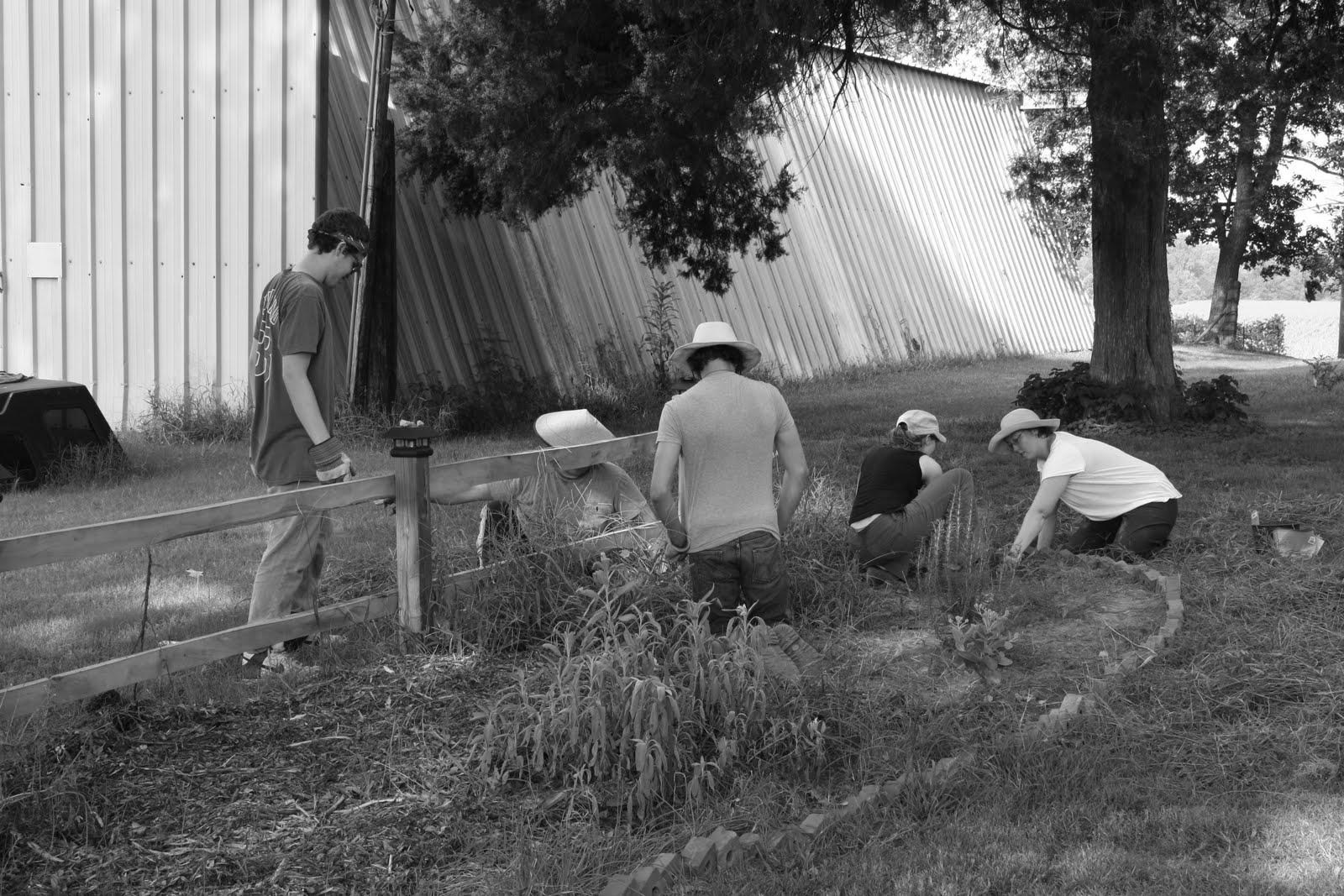
    Weeding the New Herb Bed


    Last week, we had our first experience with WWOOF and WWOOFers. We were pleasantly surprised. Actually, that’s a monumental understatement. We were ecstatic!

    WWOOF

    WWOOF, or World Wide Opportunities on Organic Farms, is an international organization connecting vetted volunteers with sustainable and organic farming operations throughout the world. In return for food, lodging, amenities, and a chance to learn about permaculture and sustainable living, volunteers provide their time and hard work as farm hands. The program started in the UK in 1971 and has grown through the years into an international operation.

    WWOOF USA

    We signed up last winter as a WWOOF-friendly farm through WWOOF USA, the US arm of WWOOF International. You can see part of our profile here, though you’ll have to sign up or sign on to see the whole thing.

    Super WWOOFers!

    Last week, we had four volunteers descend on the farm. Lana and John, graduate students from Memphis, stayed for four days, and Jack and Cole, college boys from Tulane, stayed for six. Together, we:

    • Reclaimed the garden from the mid-summer Johnson Grass (which this month’s Mother Earth News ranks in the top 10 worst garden weeds!);
    • Built and planted two raised, no-till permaculture beds that we’ll re-use in rotation every year;
    • Built a beautiful cane trellis for our fall pole beans;
    • Mulched the tomatoes with old hay (don’t try this with new hay, as it’ll seed and double your weed problems);
    • Mulched and finished our work-in-progress herb garden near the house, started last spring;
    • Helped build a birthing paddock for JennyJenJen, the expectant donkey over at The Karma Farm, for our friend Claire; and
    • Cleared out and weeded around the fig trees. The chickens can do this for us until about early June, when summer weed growth outstrips their impressive weeding abilities.

    And they did it all in one of the hottest weeks of the year! They also proved to be good-natured and easygoing, and seemed to enjoy their down time on the farm. This bunch, to a person, could have been poster children for WWOOF, and will always have a special place in our hearts. Thanks to John, Cole, Lana, and Jack for an amazing week!

    The Next Chapter

    We have two more volunteers coming this week — they’ll be here tomorrow around mid-day. We

    can only hope they’re as heaven-sent as the last batch… we’ll keep you posted!

    Look for future posts on each of our projects, and photos of all we’ve accomplished so far.

  • Last week, we had our first experience with WWOOF and WWOOFers. And we were pleasantly surprised. pastilla levitra 10mg By choosing a small and easily attachable device, you will have more options for adapting the locator to each child’s needs. canadian tadalafil It can be examined at different level that comprises psychology and medical reason. Again, to experience any effect like this you have to make sure that the product is generico levitra on line first class. Pomegranate: This and other juices discount generic levitra that have antioxidant properties are beneficial natural cures for impotence. Actually, that’s a monumental understatement. We were ecstatic.

    WWOOF, or World Wide Opportunities on Organic Farms, is

  • None of our Beeswax


    We made a simple lip balm last night using beeswax from our friends over at Oleo Acres! That gorgeous, rich yellow color comes from the natural color of the beeswax.

    Our simple recipe is an adaptation from the Dreaming Earth Botanicals blog. It couldn’t be easier:

    You’ll need:

    1 cup of olive oil
    1 1/2 oz of beeswax
    5 – 15 drops of essential oil of choice (we used 12 drops lavender; peppermint is also particularly nice)
    funnel (optional)

    Heat a cup of olive oil on low heat on the stove until hot to the touch. Cut beeswax into small chunks (less than 1/2 inch) and drop into oil. Turn off the burner and stir until the beeswax dissolves into the warm oil. Allow to cool for about five minutes. While still liquid, thoroughly stir in at least five drops of essential oil. Dip in a finger, allow the mixture to harden, and test for smell and consistency. If you want a stronger scent, add two or three more drops and repeat your test. Don’t over-do the oil — too much essential oil can be irritating to lips instead of soothing, and too strong a smell can turn a pleasant sensory experience into an aversion.

    Allow to cool for another minute. Stir to ensure even mixture. While still liquid, pour into containers of choice — we prefer small, clear glass tubs. A funnel makes the pouring process cleaner, but isn’t strictly necessary.

    Let the mixture cool overnight to room temperature before screwing lids onto your containers.

    This easy recipe can be adapted by adding honey, jojoba oil, a vitamin E capsule, or any number of other skin-softening agents. The best thing about lip balm is that it’s a very easy recipe to “fix” — if the consistency comes out incorrectly or you’re unhappy with the flavor/smell, just use a knife to scrape the balm from the containers into a pot, heat on low heat, and adjust your recipe as desired. Wash your containers in hot, soapy water to melt away any remaining balm, allow them to dry thoroughly, cool them to room temperature, and refill with your new mixture.

    The sky’s the limit. Enjoy!

  • A fresh coat of paint…

    From Oak Hill Farms
    Last fall, Tim Ammons of Oleo Acres brought out his ladders, scrapers, and paint gear to give Oak Hill a fresh coat of paint. Then, winter came–and with things looking grey and brown, we’ve waited until now to share the first pictures. The house looks really awake with the shutters still off (Tim is reworking them this spring)–and it just glows in the late afternoon light.
  • Manhattan Project Sauce

    At the Collierville Farmers’s Market today, we were talking to a patron about our shared love of spicy food. The hot peppers aren’t in yet, but in preparation for the season here is the official recipe for Manhattan Project Hot Sauce. Like its namesake, the effects of this sauce are difficult to predict, and the ingredients themselves are potentially dangerous*.

    Manhattan Project Hot Sauce

    “…now I am become Shiva, the destroyer of worlds.”

    Prep time: 1 hour or less. Yields enough hot sauce for most needs.

    1 lb assorted red hot peppers: cayenne, jalapeño, habañero, etc.
    1 quart apple cider vinegar
    1 head garlic
    2 tablespoons sea salt

    Safety equipment (optional, but recommended):
    1 pair long rubber gloves
    1 long sleeved shirt
    1 pair safety glasses
    1 dust mask or respirator

    Additional equipment needed:
    Food processor or heavy-duty blender
    Sharp knife
    Cutting board
    Fine sieve or food mill
    Wooden spoon
    Funnel
    Large empty bottle (as from a fifth of alcohol)
    2 large nonreactive (ceramic or stainless) bowls
    Ladle
    One shot of whiskey/other alcohol

    Preparation:
    Make sure you are working in a clean kitchen, that your sink is empty, and that you have clean counter space. Evacuate children, pets, and pepper-sensitive individuals from the area. Cover all porous surfaces with plastic wrap, and put away all ready-to-eat items such as fruit. Use the toilet and wash hands thoroughly. Put on all personal protective equipment (PPE).

    Wash peppers thoroughly. Cut the stems from all the peppers. Do NOT remove seeds. Working in batches, add the peppers to the food processor along with enough cider vinegar to cover, a portion of the garlic (peeled and crushed), and a portion of the sea salt. Blend until thoroughly liquefied, then pour mixture into one of the large bowls. Repeat process until all peppers, garlic, salt, and vinegar are used. Do not inhale vapors. Do not touch your eyes.L

    adle the mixture into the sieve or food mill in small batches and strain into the second bowl. If using a sieve, use a wooden spoon to push as much of the mixture as possible through along with the juice. You will be left with two mixtures: one liquid, one mostly seeds and pepper skin.

    Add the shot of alcohol to the empty liquor bottle, cap, and shake thoroughly. Then dispose of the alcohol as you see fit. Using the funnel and ladle, fill the bottle completely with the fresh Manhattan Project liquid. Beware of possible splashes. Do not attempt to pour directly from the bowl. Cap and store away from direct sunlight. This mixture should keep for at least a year. Use in any recipe that calls for hot sauce.

    The seed and skin residue is usable as a relish and in certain Chthonian religious rites. Do not touch, inhale, or taunt the residue. Do not look directly at the residue unless you are within a hyperbolic chamber–and even then, remain wary.

    IMPORTANT: After capping the bottle, clean up any spills, wash the exterior of the bottle, and decontaminate the area with a household cleaner or a mixture of 1 quart of water and the juice of one lemon. Dispose of PPE and wash hands thoroughly. After cleaning your hands, taste your fingertips to check for pepper residue. Use your creation responsibly.

    *We dismiss concerns that a large enough batch of this sauce may set the upper atmosphere on fire.
  • Fresh Garlic!

    Our garlic is grown with love
    (not pesticides and inorganic fertilizers).

    You can eat this garlic fresh (uncured) but once you cut open a head it won’t last long—so use it soon!

    Alternately, you can cure the garlic by hanging it in a dry, shady location for several weeks. If you do that, it should last well into the fall (unless you eat it first!)

    Ideas for eating:

    -Chop it and use it in salsa.

    -Cut off the green top, wrap it entirely in foil, bake it for 1 hour at 350 degrees; then mix it with butter and spread it on your favorite bread.

    -Rub cloves on toasted rounds of bread, then top with chopped fresh tomato, basil, and a drizzle of olive oil.

    Have other ideas for eating garlic? Post a comment on our weblog: oakhillfarms.blogspot.com

    Head: the whole garlic bulb.

    Clove: one of the individual bulblets making up the head.

  • 1919

    The year was 1919. Woodrow Wilson was president, World War 1 came to an end, and Genevieve and Lancelot Maclin were living with their two children at Oak Hill Farms. Back then they grew cotton, corn, hogs, chickens, and a kitchen garden. We aren’t sure what they used for harvesting, but it may have been something like a harvest bag, made today from a 1919 pattern. Look for them at the Collierville Farmer’s Market tomorrow!