Blog

  • Week 6: Farmville

    It takes a village to fill a box. With the strange weather this spring, we’ve had to replant some things and others are either gone or off schedule. Enter two other farms: Tim and Betty at Oleo Acres and Michael at the farm-formerly-known-as Cluck-N-Neigh.

    Tim provided the sweet potato, basil, and oregano; their farm has frequent events and an active web presence (look for them on The FaceBook). Michael provided the June apples and the Mirabelle plums. Thanks, friends!

    Plums, apples, onions, beets, mixed kale and collards, sweet potato, basil, and oregano!

    Since you have seen kale, onions, and beets I’ll focus on what is new this week:

    • Apples: These are semi-tart  and totally untreated with any pesticides or wax. We love them raw, but they are also amazing baked. If you are feeling crazy, bake them with brie.
    • Plums: Mirabelle plums are tiny and sweet (if you have a few that are firm and green/yellow, put them in a paper bag overnight. Eat them like candy, or try plum galette.
    • Sweet potato: Yes, you can bake this, roast it, boil it, as you please. IF you have a spiral veggie slicer, spiral apple peeler, endless patience with a knife, or a bored friend try this: turn the whole potato into one long noodle (or two or three if they break.) Drizzle with olive oil, add chopped oregano, salt and pepper, and grill.
    • Basil: It is all better with basil. If you have never thought of basil in dessert, now is your chance. Use it with anything chocolate, or try basil ice cream!
    • Oregano: You can plant this in damp sand or soil and possibly get rooted cuttings. Or, use it in your cooking–see sweet potatoes above. Don’t restrict this to italian food! Mexican, greek, indian–they all work with oregano. (Try it chopped over hummus!)

    Thanks for being part of the spring CSA! We have exactly one small cucumber, with many more on the way–plus peppers, tomatoes, eggplants, and more. Stay tuned for summer!

  • CSA Week 5: Into the Sun!

    Finally, a sunny day (even though it rained again in the evening) for our Thursday CSA delivery. This spring has been both unusually cool and ridiculously wet–and because of that we have lost crops. The CSA rolls on, but our summer crops that we should have been starting to pick (squash, beans, chard, etc.) are either delayed, stunted, or replanted.

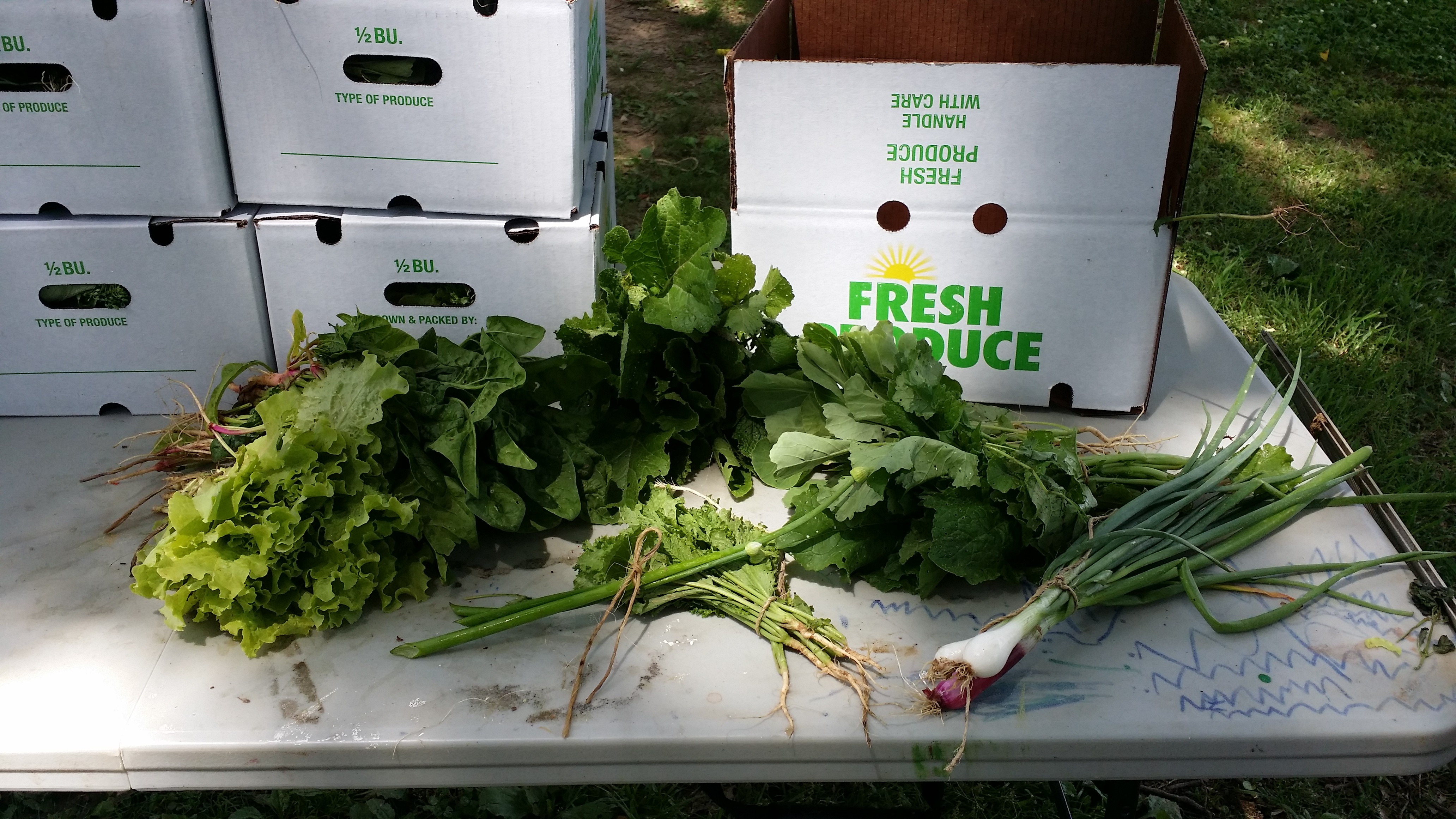
    Leftish to right: Kohlrabi, radishes, sage sprig, collards (with the red ribbon), baby swiss chard, onions, kale (tied with twine).

    On the brighter side–we have had a spectacular run of greens! With one week to go, this week’s box is light, but we should be able to finish strong in week 6. And, even though the box is not as full as we had hoped, we do have a new addition: kohlrabi!

    • Kohlrabi: This unique plant is delicious raw or cooked. The fleshy bulb-like stem has an almost nutty flavor, and the leaves can be used like any other green (see collards).  Note that a few of our kohlrabi had either cracked stems from incessant rain or munched leaves–but they will still be delicious. It is great roasted, but here are 5 recipes to get your mind going.
    • Radishes: Tired of radishes? Still using them in salad? Try a radish martini.
    • Onions: here are even more ideas for using green onions, from Martha Stewart.
    • Sage: Sure, you can let this dry and burn it like incense to clear away stale air–but you can eat it, too. Sage doesn’t get enough play in American food. That sage sprig is just enough to make a butter and sage sauce to pour over pasta (I’d add a caramelized onion, too!)
    • Collards: How about a collard (and/or Kale) and wheat berry risotto?
    • Baby chard: The chard makes us a little sad–because it was coming along beautifully until the big storm last week. Since then we’ve seen it struggle, and so decided to harvest it now to make room for another crop for summer. Baby chard is especially tender; chop and saute it with some garlic in a little olive oil–add pumpkin seeds and a splash of hot sauce, salt and pepper.
    • Kale: A couple of weeks back we mentioned kale chips; how about stuffed kale rolls with quinoa and goat cheese?
  • Spring CSA Week 4: beets me!

    Two years ago, we were covered up in beets. CSA members complained–too many beets! This year, we planted and replanted and the beets are just now coming in. This is a great example of how crops can vary from year to year, depending on the climate and other factors. Never fear, though!  Thursday boxes contain at least one (large) or a few (small) golden beets–the finest, most beettastic root veggie that I can think of.

    This weeks box contains:

    • Golden beets! The greens are delicious (the greens are, essentially, Swiss chard) and the root is great raw or–better yet–roasted. Wrap the whole root in foil and bake it like a potato. The skin will slide off and you will be left with sweet, beety, deliciousness.
    • Onions
    • Turnips: we actually plant two varieties of turnips. “Purple top” makes a beautiful white and purple root, and “seven top” makes a somewhat homely roost but beautiful greens. This week you get both, in two bunches.
    • Radishes: Check out this recipe for pan-seared radishes and radish greens (among others).
    • Butter lettuce (the green one)
    • Red leaf curly lettuce (the curly red one)
    • Lemon balm: this is in the mint family and has a strong lemon scent. It is wonderful in a salad dressing, on a salad, or cooked (like in this lemon balm cheescake).
    • Daylily flowers: yes! you can eat both the flowers and the buds. Try them fried, with eggs, or just on a salad.
  • Spring CSA Week 3: Picking in the Rain!

    Reminder! Please return your empty CSA boxes! We have 2 boxes per CSA share, and each week we fill one and hope to get one empty back.

    I love the spring rain. One of my favorite outdoor activities is running in the rain, but I also like picking veggies in the rain. Shoes become useless weights, and I get to feel the squish of mud between my toes–somehow that squish makes my feet feel cleaner, less embalmed and more alive.

    This week we have another full box with a couple of new non-green items, plus more spring greens! Read on after the break.

    (more…)
  • Spring CSA Week 2: Wilder about greens!

    This has been a strange spring; last year, we were all about the kohlrabi. Year before that, we had beets (and beets, and more beets). This year, we are covered in greens! Turnip, mustard, spinach… greens everywhere.

    We have beets and kohlrabi (technically, that counts as a green, too) coming–but we have had to replant a couple of times due to the odd weather. Here is what we have on tap for this week:

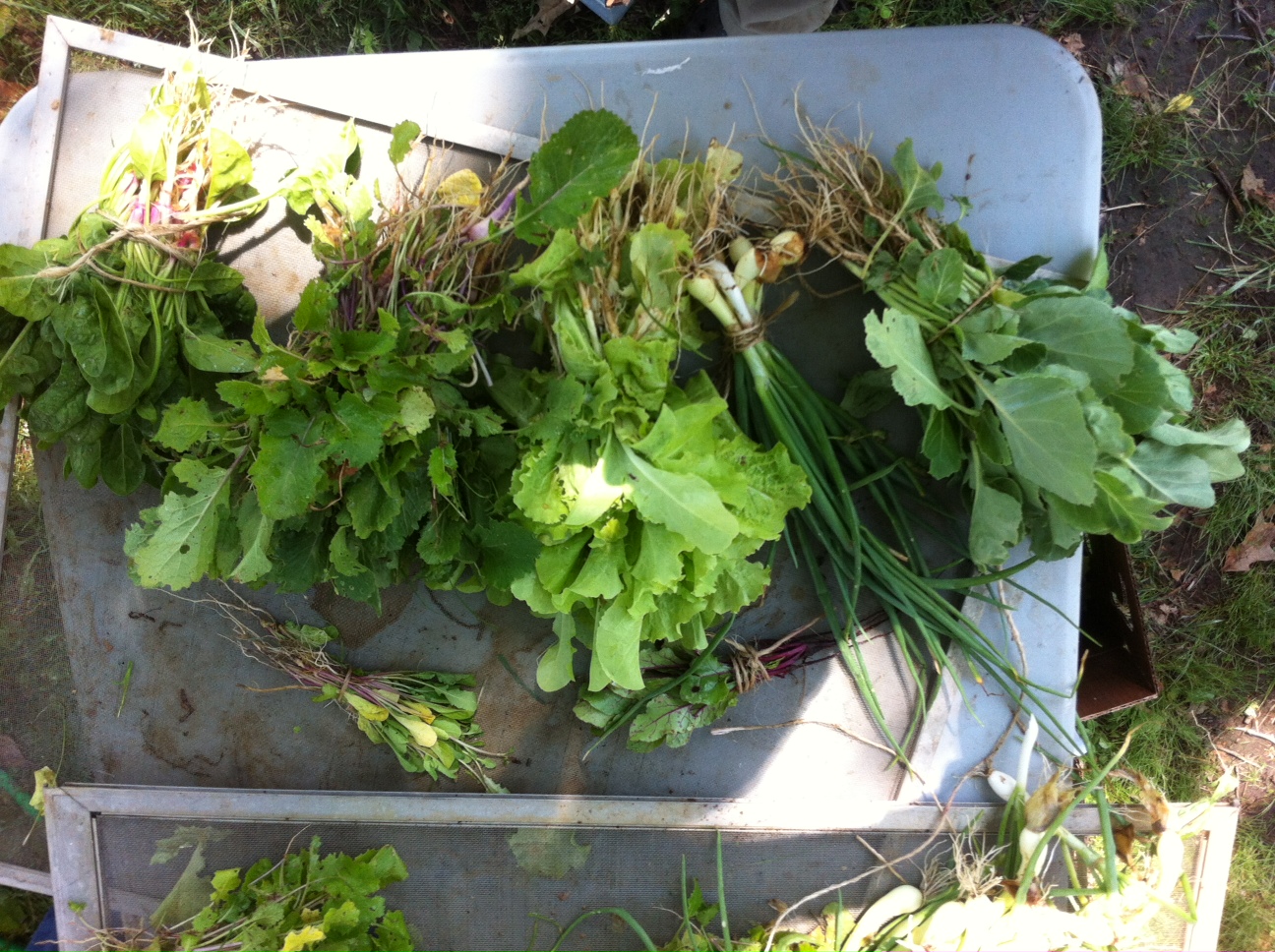
    Left to right: Green leaf lettuce, turnip and mustard greens, spinach, collards, curly mustard, broccoli raab, green onions, onion scapes (center).
    • Green leaf lettuce is nearing the end of its cycle–don’t worry: there is other lettuce coming next week.
    • Greens, including: Turnip/mustard greens, Spinach, Collards, Curly mustard : Lots of greens, still. A quick search for mustard greens turns up dozens of recipes. All of these are full of essential nutrients–we need to eat more! If you are looking to kick it up a notch with something new, try this recipe for Italian white bean and mustard green soup.
    • Broccoli raab also known as rapini is in the box! This is our first successful attempt at sending this through the CSA; last year, it was not yet ready one week and past ready the next. This is great sauteed with garlic (or green onions) in a little olive oil to wilt, then seasoned with salt, pepper, and a dash of balsamic vinegar.
    • Green onions are  plentiful this year in our garden. Looking for something new? Try green onion pancakes with ginger dipping sauce!
    • Onion scapes are a seasonal delicacy. We only had enough for a few per box; you can use them anywhere you would chop green onions, but try this onion scape pesto with pasta for a light spring meal.
  • Crazy About Greens! CSA Week 1

    Spring 2014--Week 1! Spinach, Mustard/turnip greens, Lettuce, Green Onions, Collards, Arugula, baby beet greens.

    Spring 2014–Week 1! Spinach, Mustard/turnip greens, Lettuce, Green Onions, Collards, Arugula, baby beet greens.

    Welcome to the Oak Hill Farm Spring 2014 CSA!

    A few opening notes:

    • You should wash your veggies before eating them. We rinse them lightly when they come from the garden, but there may still be soil or critters attached.
    • “There are holes in the leaves!” We try to keep munching insects to a minimum, but the bugs need to eat, too! We grow without synthetic pesticides or herbicides, so some hitchhikers are to be expected.
    • Check the blog each week for a list of box contents and recipe ideas.

    Now, on to the contents! This week we are heavy on leafy greens:

    1. Green leaf lettuce: Super fresh, great for salads (of course) but try it as a wrapper for chicken lettuce wraps.
    2. Spinach: Popeye was right, but his was never this fresh. Everyone has their favorite way to eat spinach; this spring we are on a saag paneer kick!
    3. Collard greens:  A favorite way to cook collards or ANY other leafy green: sautee garlic/onions in 1tbsp olive oil, add greens to wilt; once wilted, add salt/pepper and a sprinkle of balsamic vinegar. Serve with hot sauce if desired.
    4. Turnip/mustard greens: Some boxes may include tiny turnips; we love mixed turnip/mustard greens with chopped turnips prepared as above (see collards).
    5. Arugula: Arugula martini. Yes–I said arugula martini.
    6. Baby beet greens: Just a taste, add them to a salad or other greens for color. Look for more, larger, beets (and greens) in later boxes.
    7. Green onions: We should have a steady supply of onions for the next few weeks.
    8. Mint: An extra treat (not pictured) just to make the box smell nice. If you plant it in the next day or so into damp soil in a pot, you can start your own mint garden. Also great dried, fresh, in tea, or 1000 other ways!

    Look for more veggies next week!

  • New Apple Orchard

    Apple blossoms
    Apple blossoms on newly-planted trees, April 13, 2014

    On Saturday, April 12, we had a visit from a large group of volunteers for apple tree planting. Our friend Robin works for St. Jude Children’s Research Hospital where she manages immigration services; she organized the volunteers and the whole tree planting day. The volunteers included friends as well as researchers from over 20 different countries–all of them came to plant apple trees, and many of them brought their families.

    “An acre of orchard each season fixes about 20 tons of CO2
    from the air, releases 15 tons of oxygen, and provides over 5 billion BTU’s of cooling power.” (Lakso, 2010)

    All together, more than 50 people sponsored trees, and we now have an orchard of 50 apple trees! We purchased the trees from The Stockyard nursery in Arlington–they worked with us on the price, and the trees were all healthy. Now, nearly two weeks later, all 50 trees are still alive and well. The trees are red and golden delicious, fuji, McIntosh, and Anna, and so they are variously suited for pies, eating fresh, and cider. With some tender loving care and cooperative weather, we may have a few apples as soon as this year, and many, many more in years to come.

    We have dreamed of adding more fruit trees for years, and then this gift came to us unexpectedly. A huge thank you to everyone who helped! Look for photos as the seasons progress!

  • The Glory of Repair

    “…farming is about twenty per cent agriculture and eighty per cent mending something that has got busted. Farming is a sort of glorified repair job.” -E.B. White

    I was just reading online a story about E.B. White’s farming career, leading to the writing of his classic, Charlotte’s Web.

    In the quote above, White talks about the importance of repair work in farming. Just this morning as we were preparing to plant vegetables, we spent an unexpected hour working on the tiller–the same tiller that I just worked on last night. Luckily we have boxes and bins full of old bolts, so these sorts of repairs are not necessarily difficult, just time consuming.

    It wasn’t at all White’s intention, but I like to think of farming as a repair job in two senses. One, it is a job that requires a lot of ‘fixing things.’ Things get used, and inevitably they break. Hoe handles, drill bits, bolts, chains, belts, and all manner of equipment end up on the operating table (or shop floor).

    But, repair also means “to come together” or “a popular gathering place.” Farming is not a lonely job; it is often done with help from friends, family, and neighbors, and the farm itself can be a gathering place. So, farming is a job to which one may repair. If you would like to join us at the farm, think about coming to our Spring Open House on April 17 (rain date TBD if necessary.) Because sometimes, we all need a little repair.

  • Summer CSA Week 3

    Hi, friends!

    So I promised to update the blog this week since the box had a couple outliers in it. I’ve been remiss in weekly updates. Our busy season is now our wonderfully-horrifically-stupendously-insanely-busy season, and the blog has been falling off the radar. But this week, I’m back! Here you go:

    Summer2013CSAWeek3
    Clockwise From Top: Figs (two varieties), green beans, pears, loose-leaf lettuce, rosemary, tomato (or two), radishes, radish greens.

    Our box this week mixes the best of summer and fall. Our tomato production is starting to drop off, but our fall lettuce planting is starting to come in!

    • Figs: We had a double crop of figs this year, and these are some of the biggest we’ve ever seen on this tree.  You’ll also find some smaller ones mixed in, from a different tree variety that is nearing the end of its season. The big ones should continue for another week or two. Eat them fresh on a salad; bake them with honey or sorghum and have them for dessert over ice cream or marscapone cheese; or dehydrate them in the oven or a dehydrator. To get juice for jelly, cover them with water, boil for 20 minutes, pour through a colander, let sit for 8 hours, and reserve the juice for jelly. The juice will freeze nicely if you want to do all your jelly making at once. Jam or jelly questions? Email them to me at oakhill1832@gmail.com.
    • Green Beans: Boil them with aromatic herbs or stir fry them for a slightly crunchier dish. They freeze wonderfully, too. Drop them in boiling water for about 3 minutes, until they turn bright green. Remove with tongs and drop straight into ice water. Allow to dry on a paper towel, pack into a plastic bag, squeeze out as much air as possible, label with the date, and pop them in the freezer.
    • Pears: These are lovely in pies, sliced fresh over a salad, canned, or jellied. I love to eat them fresh, but they are harder than the Anjou pears you’ll find in stores. This is heirloom stock planted by Ted’s grandmother.
    • Lettuce: We thinned the lettuce this week. It’s warm enough that some of it may bolt before next weekend, so we wanted to make sure you got a taste of our most recent lettuce planting. Enjoy this in a salad while it’s fresh, or slice the tomato, cook up some bacon, and have a BLT.
    • Rosemary: Rosemary, figs, and pork make an excellent combination. We like to stuff a whole tenderloin or thick-cut pork chops with a few sliced figs and rosemary–sometimes with a soft cheese if we’re feeling decadent. Roast or cook in a skillet for a really delectable experience.
    • Tomato: Set in the window sill for a day or two if it needs further ripening, slice, and add to sandwiches or salads. There’s nothing like a truly fresh tomato.
    • Radishes: Our radishes are going gangbusters–they’ve loved the cooler weather and are taking off with the heat at the height of their life cycle. We thinned this week, so I’ve included both finished radishes and immature greens. Check out these recipes for gluten-free radish soup and radish top soup–or add to stir fries and fresh salads for a bit of bite.
    • Radish Greens: As I said, great in soups, salads, or stir fries. They’ve got a super-distinct flavor, so adjust the amount to your taste.

    Happy cooking! We’ve loved sending out full boxes of fruits and veggies, and we hope you’re having fun with them. Wish us luck in the weeks ahead… Fall is closing in!

    Peace, Love, and Veggies,

    Ellie (and Ted and Evie)

  • Hog Share Friends! The time has come!

    This coming Monday we are taking five of our hogs to Yoder Brothers Meat Processing in Paris, Tennessee for processing for our current Hog Share members. Yoder Bros. is a USDA inspected processing facility, family owned, and has so far been great to work with.

    Hog share members have mostly paid for these pigs already, and any additional cost will be because of 1) weight and 2) options you select for extras. This link will take you to a list of hog share meat options/prices (PDF file):

    We will also send this out to you all via email. Thanks for supporting local agriculture!

    If you are interested in being part of the NEXT hog share, let us know. We have learned a lot about raising pigs on pasture and in woodlots, and things should be even smoother next time around.