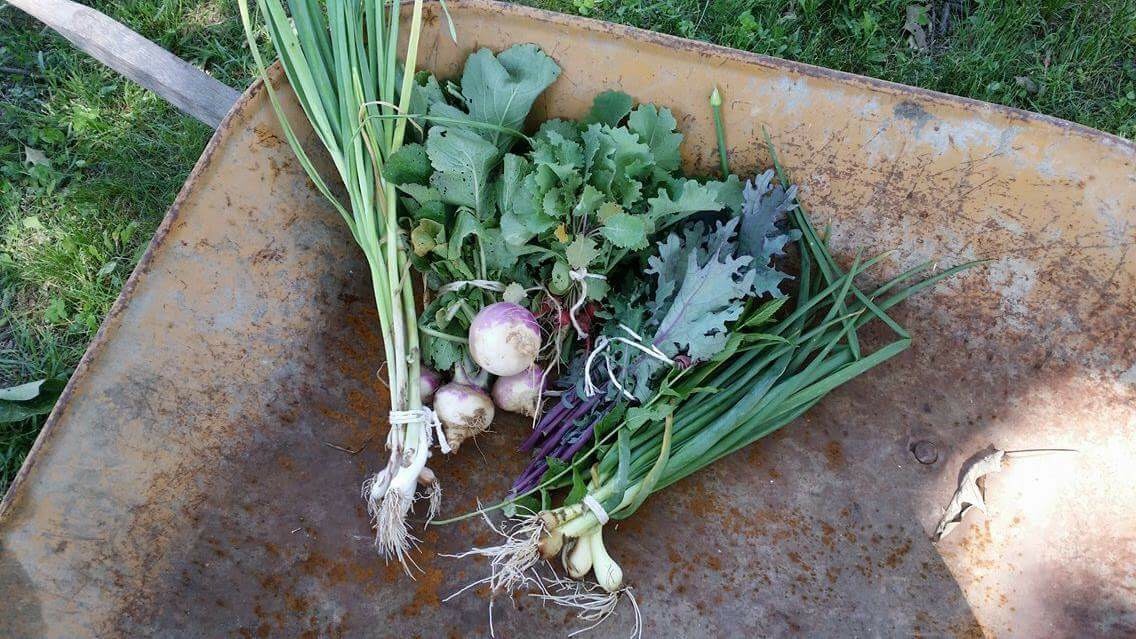
Left to right: baby garlic, turnips with greens, baby kale and radishes, Russian red heirloom kale, spearmint, spring onions.
Your second CSA delivery has been dropped off! This week you’ve got turnips and turnip greens, a different variety of kale, spring onions, baby garlic, baby kale, and radishes.
Baby garlic: You can use both the white and finely-chopped green portions of the garlic in cooking at this stage. It has a milder flavor than mature storage garlic, so feel free to add a little extra. For a special treat that only works with young, green garlic, try a green garlic pesto!
Turnips with greens: Both the turnips and their greens can be used in cooking. Delicious in soups, sauted, or roasted, turnips are one of our favorites.
Baby kale: Bundled with the radishes, this baby kale is tender and delicious as a salad green. Since we left the roots on, you can opt to plant and water them if you’d like some of your own.
Russian red heirloom kale: This is one of our favorite varieties… light and sweet, it’s delicious as a salad green. It also makes incredible kale chips–heat oven to 35o degrees, wash kale and break or cut out any large stems, then tear into bite sized pieces. Use parchment paper on a cookie sheet if you have it, or just drizzle a little oil before you spread the kale flat across the surface. Drizzle a little oil over the leaves, then sprinkle with sea salt. Bake until the edges are slightly browned and the leaves begin to crisp, about 10 – 15 minutes.
Spearmint: Makes a delicious tea or addition to lemonade, but we think it’s really good in salads, too. Try this cranberry bean salad with basil, mint, and feta cheese.
Spring onions: The light, green flavor of these little delicacies is good raw in onions or sauteed with the young garlic as a basis for stir fries or cooked greens.
Hit us up with questions and comments–or pictures of your CSA dinners–here on the blog or on our Facebook page. For more recipe ideas, you can also look over last week’s blog again. See you again next week!
Here we go! Welcome to the Spring 2016 CSA. Here at Oak Hill, we love this time of year. The world has exploded in greenery and growth and we’re starting to see the results of planning and hard work that started back at the beginning of the year. Reminder: We wash your veggies each week after harvest, but we always recommend you wash them again, most especially on damp and rainy days like this one.
This week, you have in your boxes:
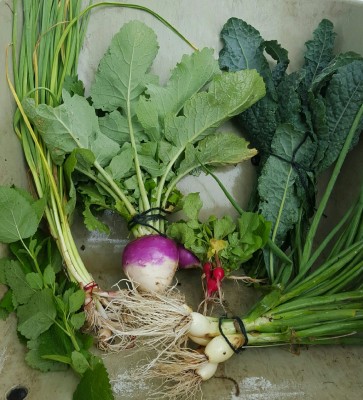
Clockwise from top center: Turnips, radishes + arugula, Lacinato kale, spring onions, lemon balm, and baby garlic.
Turnips: These year-round simple favorites soak up the flavors of anything you cook them with. Boil them on the stove and then mash them with salt and butter, or roast them with a little honey at 400 degrees until tender for a sweeter treat.
For a more adventurous favorite of ours (especially if you’ve done one of our hog shares), try this Chinese Pork and Veggie Hot Pot from Eating Well. For a down-home variant with a little Asian flare, omit the store-bought chili-garlic sauce and anise/aniseed. Instead, saute our spring onion and baby garlic (equal parts white ‘bulb’ and green stem) in a little butter or oil of your choice, sprinkle with just a smattering of salt, and use 2-4 teaspoons of that easy, homemade nomminess in place of the garlic-chili sauce. Add the toasted sesame seeds or omit, depending on availability and personal taste. If you want to add some heat, throw in a little Rooster Sauce (or try it with our hot peppers later in the year!)
Radishes and arugula: There are a million online recipes for salads that use arugula and radishes; we’re partial to this apple, radish, and arugula salad with a tasty vinaigrette. Or keep it simple… chop the radishes and their greens, wash the arugula and remove roots, and add all of it — in moderation — to a lettuce mix for a flavorful and spicy salad. Or get a little goofy… this “eyeballtini” garnished with a radish “eyeball” is a funny weekend treat with friends.
Lacinato Kale: known by other names as black kale, Tuscan kale, cavolo nero, or dinosaur kale. It was once grown for Thomas Jefferson in Monticello’s vegetable gardens, so it’s one of the oldest plant varieties in our garden this year. It is also grown in Italy; it’s a traditional ingredient in the Tuscan soup called ribollita. For more on this fascinating, everything-resistant heirloom kale, check out our blog post on the plant.
Spring Onions: Our yellow spring onions have a tender and delicate flavor. Use the stem as you would a scallion or green onion (they’re basically the same thing, just slightly more mature). Use a spring onion anywhere you’d use a storebought onion, in cooking and grilling or raw on salads. Or, along with the radishes, replace the leeks in this buttered leeks and radishes recipe from Real Simple for a hot, delicious, slightly sweeter take on these traditionally spicier delicacies.
Lemon Balm: Lemon balm is a powerful mint variety with a million uses. Delicious on a sweeter salad or as a garnish in homemade lemonade, it also makes a tea that’s delicious by itself or sweetened with honey–and that’s said to relax like chamomile and to be beneficial for stomach troubles. Bruise a handful of the leaves and drop into a glass or glass jar, cover with boiling water, and steep with a cover on it for 10 minutes so none of the vapors escape. Then drink on its own or sweetened with honey and/or lemon. Thanks to the Nerdy Farm Wife for my favorite post on Lemon Balm, 12 Things to Do With Lemon Balm–go for it! We left the roots on this one so you can plant it if you like; keep it in a pot or somewhere that it can’t overtake other plants, since it grows like crazy and can become invasive.
Baby Garlic: At this tender age, our garlic can be chopped stem and all and used in sautes, stir fries, salads, as garnishes, even in homemade bread recipes for a kick to traditional garlic bread (saute it first!).
Just a reminder: Please keep your bag; we’ll swap a full bag for that empty one next week. You’ll receive two bags as part of your share. We’ll trade out each week, and at the end of the seven weeks, the bags are yours to keep. If you lose one, you can buy a replacement from us for $8 (with or without custom artwork by our 7-year-old artist-in-residence Evie). We’ve implemented this policy because we’ve had trouble getting bags and boxes back from customers in previous years; we hope you understand.
Thank you all for joining us on this springtime journey. See you next week!
This year we are trying out several new additions to theSpring CSA, including this delicious kale variety. Lacinato Kale is also known as black kale, Tuscan kale, cavolo nero, or dinosaur kale. It was one of the plants grown for Thomas Jefferson in the vegetable gardens at Monticello, making it one of the oldest plant varieties in our garden this year. It is also grown in Italy, and is a traditional ingredient in the Tuscan soup ribollita.
Lacinato kale growing for 2016
In the garden, lacinato kale can grow up to three feet tall. The leaves are bumpy (like dinosaur skin–hence the name dinosaur kale), and are usually harvested from the bottom up over the course of the growing season. As an heirloom variety, it thrives without the use of modern industrial fertilizers and pesticides. When you cook it, the bumps in the leaves help to hold pan juices, giving you bursts of flavor with each bite.
Lacinato kale has a flavor that is slightly more delicate than its curly or Russian cousins. You can use it in soup like ribollita (literally: reboiled), or you can eat it grilled, boiled, stuffed, roasted (mmmm… kale chips!) or–our favorite–partly blanched and sauteed with garlic, red pepper, and olive oil. It is gentle enough to eat raw in a salad, but holds its own even a lasagna or casserole.
This is one that you will probably not see at your local supermarket, and that you may not see from other farms around Memphis. In April and May when the baby green garlic and kale are both coming in–look out! You might get so spoiled that supermarket food just won’t do. If you haven’t signed up for the Spring CSA yet, check it out and get in before we run out of space!
Our Spring 2016 CSA is right around the corner! We will start in mid- to late-April, depending on the weather, with salad greens, kale, turnips, spinach, onions, garlic, and more. This year we are adding several new varieties to the CSA, including Lacinato Kale (also known as black kale or Tuscan kale). CSA shares will be delivered to Memphis on Saturdays begnning in mid-April.
Pending our market application, we hope the delivery point will be the Cooper-Young Farmers Market.
We are also looking for ways to accept EBT/SNAP benefits. Fresh, local food shouldn’t be just for those who can afford it–everybody deserves good food. Watch the blog for more details as the season progresses!
Spring is in full effect now that we are (knock on wood!) out of the cycle of endless rain. This week’s box resembles the first two, but with some new additions; read on!
Clockwise from top: Kale (2 kinds), cilantro, spearmint, garlic scapes, curly-leaf mustard, green-leaf lettuce. Spring onions and garlic in the center.
Red Russian Kale and Giant Green Kale: OK; more kale. We were skeptics at first, years ago, but we are still finding new things to do. Most recent:
Grilled Kale
1 large bunch of kale 1/4 cup olive oil 1 to 6 cloves of garlic, minced (depending on your love of garlic) 2 tbsp balsamic vinegar Salt and pepper to taste
Mix last four ingredients in a bowl. Wash the kale, dry it, and toss it with the oil/garlic/vinegar mix.
Place the kale in a single layer on a medium-hot grill (about 350 deg. F). When it starts to seem crisp (about 2-3 minutes) use tongs to turn the kale. Grill one more minute, then remove to a stack on a plate. Serve alone or with other dishes.
Curly green mustard greens: If you love mustard, you can use this in a salad. We prefer it cooked–either in the traditional “southern style” with pork fat or, more often, wilted in a pan with garlic and olive oil. There is a theme here–garlic and olive oil are good accompaniments to veggies.
Cilantro: Some of you love it. Some of you hate it. If you never want to see it again (some people REALLY hate it) let us know. Bonus points if you guess what goes great with cilantro (hint: it rhymes with “car-lick.”)
Lettuce: This is black-seeded Simpson leaf lettuce; wash it well, use it like other lettuce. Ever had a wilted lettuce salad? Just barely sear it in a hot pan–then serve as usual for a salad.
Green onions: red, yellow, and/or white. We have an assortment of colors; usually in the store you only see baby spring onions in white. The different colors have slightly different flavors (really–try it).
Garlic: Softneck “Teenage” garlic. We’ve been sending you juvenile garlic; this week the garlic is a little further along–almost but not completely full-grown–so we are calling it “teenage” garlic. Like its namesake, it is stronger but hasn’t developed all of its adult character yet. Don’t try to store it for more than a couple of weeks.
“Tomatoes and oregano make it Italian; wine and tarragon make it French. Sour cream makes it Russian; lemon and cinnamon make it Greek. Soy sauce makes it Chinese; garlic makes it good.” ~ Alice May Brock, American author, b. 1941
Garlic scapes: You won’t find these at most super markets; every garlic plant doesn’t make a scape, but those that do make only one each, and the scapes are only around for 1-2 weeks. Try these sauteed in butter or olive oil, tossed with the pasta (or spaghetti squash) of your choice. Throw in some pine nuts and you have an amazing meal.
Spearmint: You can actually plant this and it will probably grow–feel free! Give the gift of mint! Use in tea, or make candied mint leaves: wash the leaves, brush them with a 50:50::egg whites:water mix, dip them in sugar, then arrange them in a single layer on a cookie sheet or drying rack. Let them dry for 24 hours (you can rush this in a Very Slightly Warm oven (~175 degrees F). These keep for a day or so in a jar at room temperature.
Red Russian kale, giant kale, mustard greens, green leaf lettuce, lemon balm, green onions, fresh garlic.
Welcome to the Spring 2015 CSA! Here is what we have in the box this week:
Green leaf lettuce (in the bucket)
Green onions
Green garlic: One of our favorite tastes of spring. Use it like you would green onions; it is not so pungent as mature garlic. You won’t believe the amazing flavor–and you will probably never find this in the store. Here are links to several recipes to make the most of this spring treat!
Mustard greens: This is a wonderful spring green; we usually sauté them with just a little garlic, olive oil, and balsamic vinegar. Here is a recipe if you don’t feel like “winging it”.
Red Russian kale: For both of our kales, you can’t go wrong making kale chips (warning: they are addictive.) Chips not your thing? Try kale in a frittata. Hint: the recipe doesn’t call for it, but a little green garlic would be amazing here.
Giant green kale
Lemon balm: What do you do with this? Well, you can take it outside (or to a pot) and bury 1/2 the stem–it should root and make more lemon balm. Otherwise, use it in iced tea, in a lemon julep (in place of mint), or in a salad (chop the leaves so they aren’t scratchy). The lemon flavor doesn’t hold up to long cooking, but the scent is amazing and a lemon balm tea is soothing.
As usual, we rinse our veggies before they come to you–but they do come right out of the garden. We don’t use herbicides or pesticides, but bugs and dirt do occasionally come along for the ride. We recommend washing your veggies before you eat
Our Seed Swap is coming up on Saturday March 28. To help things run smoothly, here are some guidelines for swappers:
Keep it simple! Have Fun!
Bring a folding table and chair(s) if you have seeds to swap. No charge for table setup.
Package seeds in small envelopes or bags.
Mark seed packs with variety name, year collected/purchased.
Be prepared to answer seed questions
Swap! Seeds for seeds!
If someone doesn’t have seeds to swap, sell or give away seeds as you choose. We will be charging $0.25/small pack (4 for a dollar) for seeds for people who don’t have seeds to swap. You set your own terms–bring your own change and keep track of your own money. Keep it simple! Have fun!
If you don’t have seeds, come anyway! We’ll have seeds and chili (we are asking for a donation for the chili). Our friends at Oleo Acres are having a propagation workshop at 1pm–right around the corner from us.
Farmers, gardeners, and plant-lovers! Bring your extra seed and share with other like-minded folks. If you don’t have any seed to swap, that is OK! Seed packets will be available by donation, too. Look for more details on our FaceBook Page.
Talk with other gardeners, share tips, and enjoy a day on the farm!
Bringing seed? Bring along small envelopes and the following information: Plant name When harvested (or year bought) Stories and tips to help other growers.
CHILI POT LUCK! We will have chili (with meat, semi-spicy) available for a donation. Bring a side dish to share and join in the fun!
BRING YOUR OWN BEVERAGES!
Weather permitting we will also have tours, hayrides and who knows what else.
We had two new litters of pigs born yesterday! Angelina Jowlie (see video, below) had a litter of 10; Kim Lardashian (not in the video) had a litter of 7.
This is the second time that our piglet births have been synchronized, and mothers and babies all seem healthy and happy. We’ve been feeding our hogs with the spent mash from the distillery of Pyramid Vodka, so we have plenty of food rolling in even though the weather is getting cold. Usually we try to time new litters to arrive with the warm weather of Spring, but like Jeff Goldblum’s character in Jurassic Park says: “life finds a way.” In this case, “the way” was through a weak spot in the fence separating the boar and the sows.
We have hog shares available for sale, and we will also be selling piglets once they reach weaning age in 6-8 weeks. Contact us for more details!
One of our favorite treats is a roasted fresh ham. People are used to pink, pre-sliced, cured ham. Fresh ham, on the other hand, is pork-colored and succulent. Think ‘pork roast’.
Our favorite recipe is a variation of one that friends in New York made once upon a time, that they in turn got from a Food Network program: roasted fresh ham with cider glaze. That said, it seems pretty hard to go wrong with a fresh ham as long as you keep a few things in mind:
If it is frozen, let it thaw completely before cooking.
Cook on medium heat; the recipe link above starts high and drops to 325, but we have also just started at 325.
Until you are really good at judging by feel, use a meat thermometer. Shoot for 165 Fahrenheit in the center.
The above recipe uses a cider glaze. Cider is both sweet and slightly acidic, and those are both nice compliments to the meat and its fat content. Other examples: figs and balsamic vinegar, pears and dry wine, even your favorite cola (in theory.)
A fresh ham makes a great presentation, and is big. Make it for friends, with feel-good sides like roasted potatoes, roasted Brussels sprouts, or beet and goat cheese salad.