Welcome to WordPress. This is your first post. Edit or delete it, then start writing!
Category: Uncategorized
-
Beginner Gardening Resources
Ted here! I’ll be leading a Beginner Gardening workshop at the Memphis Mushroom Festival on Saturday, Nov. 4, 2023 from 10:30 – 12:30. The web is full of resources for gardeners–so much so that it can be overwhelming. Here are a few that I find really useful:
What to plant (based on your area):
Baker Creek Seed Co. (mostly veggies)
TN Nursery (Fruit trees)
Oak Hill Community Nursery (Shameless self-promotion)
Wild Ones Mid-South Chapter (Native plant resources)
When to plant:
For veggies, see the Urban Farmer planting calendars—look for Memphis in Zone 8.
For perennials, including trees, the best time to plant is usually early Fall or early Spring. The worst time is usually mid-summer.
Plant garlic in the fall—after Labor Day but before Halloween.
How to plant:
Planning for Square Foot Gardening
How to make more plants:
Propagating plants from cuttings
Cheap Garden Hacks:
Seed library (Memphis)
-
Spring CSA Week 7
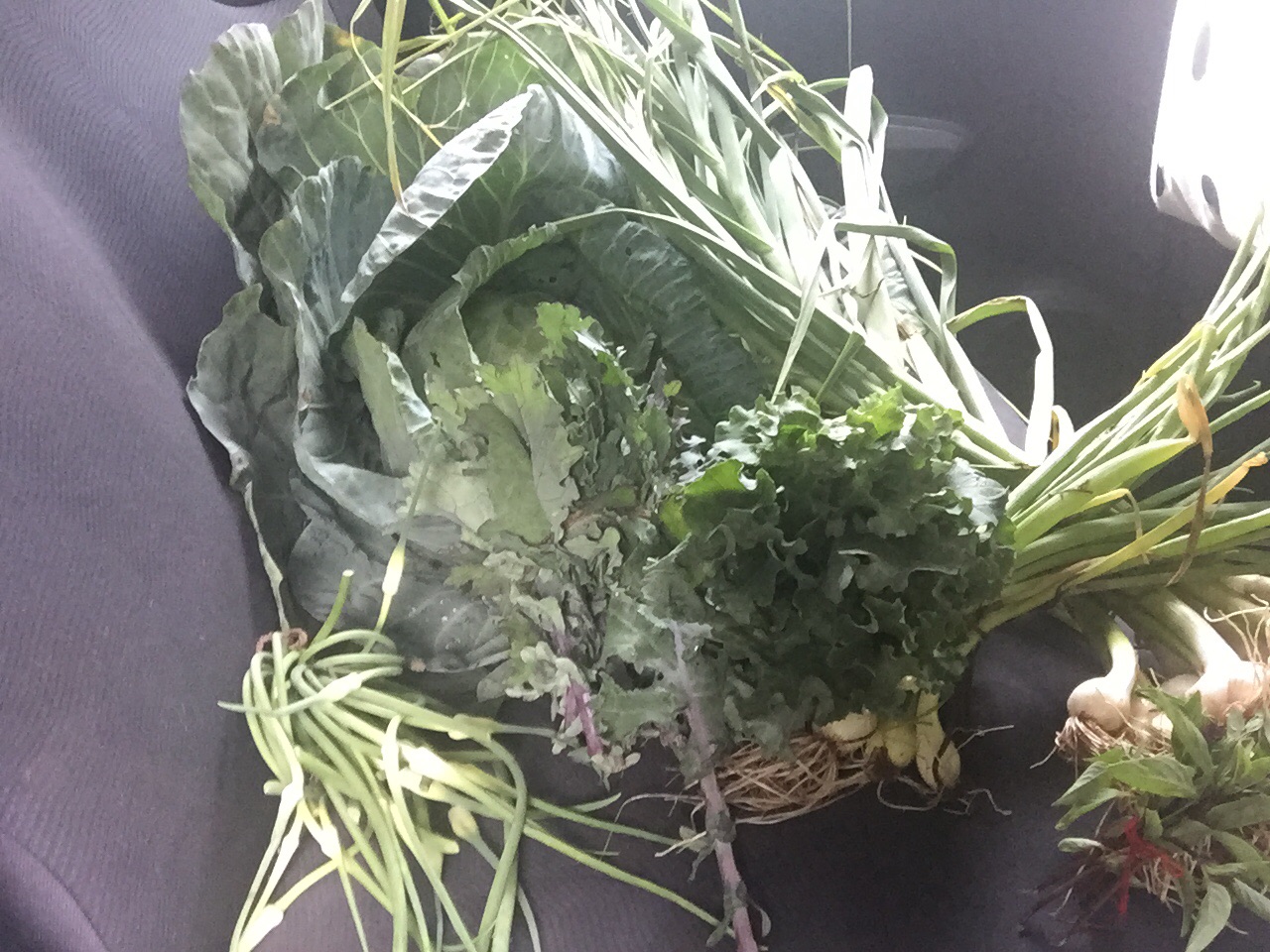
Last week of the Spring 2016 CSA!
In the bag this week:
Spring onions:
Garlic:
Broccoli greens:
Green kale:
Lacinato, AKA Tuscan, kale:
Cabbage:
Basil:
We’re off to deliver veggies–more details and photo later!
-
Spring CSA Week 6
It is raining. Again. We’re not ones to complain–if it was a dry spring we’d be wishing for rain. We had enough of a dry spell mid-week to plant okra, corn, and purple-hulled peas, though they may not produce until late summer. This week: Cabbage for All! This is exciting for us; up until this year, bugs have always eaten our cabbage or the crop has failed for other reasons. One year, the hogs escaped and walked through the garden eating just the heads of the cabbages. What else is in the box? Read on!
Garlic: We really can’t call it spring baby garlic any more. Our babies are growing up!
Heirloom garlic scapes: These are special. Not only are they from out limited supply of heirloom garlic, they are only produced during a very short spring window. The whole scape is edible! We chop them and add them to eggs, to soups, over pasta–and don;t limit them to being a garnish: the scape can be the star! Follow this link for a list of seven ideas: we especially like using them in a pesto, minus the basil. Just garlic goodness!
Spring onions: Earlier this week Ted made dinner using these onions, leftover pulled pork, tomato sauce, and spices: Pulled Pork Tikka Masala. Substitute your favorite meat, tofu, or veggie if you don’t have leftover pulled pork barbecue:
Pulled Pork Tikka Masala
1 bunch spring onions, chopped
1 tsp cumin seed
1 tbsp oil
1 1/2 tsp turmeric
1 head spring garlic
1 inch fresh ginger or 1 tsp dry ginger1/2 tsp pepper
1/2 tsp salt
1 small container plain yogurt
8 oz tomato sauce
8 oz heavy cream or whole milk
1 lb leftover pulled pork
1 tsp garam masala
Thai basil, choppedSaute the onion and cumin over medium heat until the onion is golden. In a blender, make a paste of the garlic, ginger, turmeric, salt, and pepper (add a teaspoon of water if needed). Add the paste to the onion and stir until it begins to brown. Add the cooked pork, yogurt, tomato sauce, and cream and stir to mix. Simmer 10 minutes. add the garam masala, serve with a little Thai basil on top.
Cabbage: If you are NOT eating healthy, try this recipe for Polish Bacon, Cabbage, and Potato casserole. If you ARE eating healthy, try grilled Teriyaki Cabbage Steaks.
Russian red kale: Kale is back! Ok–you’ve had a lot of kale, but it is versatile. Have you made kale chips yet? Please say yes… If not you should really try it: coat the leaves with a little olive oil, salt, and pepper and bake them (or grill them) until they are crispy. This is a great side or snack.
Hot peppers: You are only getting one or two of these–they do have a kick; if you don’t like spicy, share with a neighbor. If you do, chop them and add them to anything!
Thai basil: Unlike its big-leaved cousin, Thai basil has smaller leaves with a complex scent of lavender, licorice, and basil. It is hard to describe if you’ve never had it–but it is a classic herb throughout southeast Asia. You can use this almost anywhere (see the pork recipe above), but it is especially good with garlic and just a little spice. Let us know what you think!
-
CSA Week 5: We got the beet.
There is a lot of love in this week’s box. It isn’t just that we love veggies, or that kale is showing us a lot of love this year. It’s the beets. We love beets. A few years ago we had the Year of the Beet, in which all of our beets grew to full size and customers got tired of seeing them. This year, three of our plantings of beets were washed out by heavy rains, and what you see this week is most of what survived. We debated leaving them another week in the ground, but they were calling us: “pull me!, pull me!” At least it sounded like they were calling us. Did I mention that we love beets?
We’ve heard rumors that some people dislike beets. To them we say, you might be doing something wrong. Now we aren’t ones to tell you how to cook, but if you hate beets and the only way you’ve had them is boiled or canned, try roasting them. Just cut off the leaves (save those!!) and the tip of the root, wrap each beet in foil, and bake in a 350 degree F oven for about 45 minutes. Let them cool and the skin should slide off. From there you can cut them into chunks and serve with feta cheese and walnuts, put them in a salad, or eat them whole like an apple.
As for the beet greens, they are great raw or cooked. They are, essentially, Swiss chard (chard and beets are different varieties of the same species, Beta vulgaris.) The classic preparation is to saute them in just a little butter with onion and garlic just until they begin to wilt. For example, this recipe (which adds Parmesan cheese).
Enough about beets, though. On to this week’s veggies!

Clockwise from top: Lacinato kale, beets, spring garlic, green curly kale, green onions, “salad helper” bundle, basil in the middle. Lacinato kale (or cabbage!): If you got kale last week, you will have cabbage this week–but for most of you you are getting kale two ways: lacinato (AKA Tuscan) kale and green kale, below. As it warms, try something cool like this cold kale and apple soup.
Green kale: Everyone gets kale this week! Here is one of our favorite recipes; please experiment and share! This is great for breakfast, lunch, or dinner and can be made oversized to feed a group, tiny to feed one, or ahead of time for an event.
Crustless Quiche with Kale
1/3 cup cooked quinoa
4 eggs, beaten
1/3 cup milk
1/3 cup feta cheese
1/3 cup parmesan
1/3 cup cheddar
Salt and Pepper to tasteWe added:
1 cup chopped Kale
3 chopped mushrooms
1 chopped baby garlicPreheat the oven to 350 degrees. Butter a glass pie pan. Mix all ingredients, pour into pan, bake for 45 minutes. We actually baked it for 30 minutes, then turned off the oven and came back to the house an hour later, and it was fine. This is a forgiving recipe–play with it!
Beets: See the top of this blog post for recipe ideas.
Spring onions: Since you are getting these pretty much every week, here is yet another idea for green onions: green onion soup! Great as a starter or as a light meal–just be sure you wash the onions thoroughly to avoid any dirt!
Salad helper bundle: As we mentioned last week, the spring rains this week washed out most of our lettuce. Still, we can’t let the little bit that is left go to waste. These tiny bundles are enough for a salad for one–or to use as a “salad helper”. You can add kale and beet greens to liven them more. Included in the bundle: 1-2 radishes, tiny baby lettuce, spinach.
Basil: Unlike lettuce, our basil is starting to really take off. We included one sprig this week–not enough yet for pesto, but enough to chop and serve over a simple pasta dish, eggs, soup, salad, or in the quiche dish above.
Spring garlic:
Garlic Breath
by Shel Silverstein
Little Seth had garlic breath–
Said hi to his sister and breathed her to death.
Breathed on the grass
And the grass all died.
Breathed on an egg and the egg got fried.
Breathed on the air and the air turned green.
Breathed on the clock and it struck thirteen.
Breathed on the cat and the cat went moo.
Breathed on the cow and the cow gave glue.
Breathed on his brother,
His brother went blind.
Breathed on his mother
And she lost her mind.
Breathed on a top
And made it spin.
Breathed on the house
And the walls caved in.
Breathed on his feet and they ran from Seth,
Just to get away from his garlic breath -
Spring 2016 CSA: Week 3
We love spring! Part of the joy is the growth of the season–but part is the surprise factor. Every year is a little different based on weather, shifts in weed and pest populations, stray deer, and other wildcards. Three years ago, for example, we refer to as “the year of the beet” because all of our various plantings of beets flourished. This year has started out as the year of the turnip–we were going to give you all a break from their deliciousness this week, but the fluctuating weather has started some of them bolting.
This week’s box is full of surprises, thanks in part to our neighbors and long-time friends at Oleo Acres, who provided some of this week’s diversity. On to the veggies!

CSA Week 3: Clockwise from left: Turnips with greens, spring onions, horseradish leaf, apple mint, collard greens, spring garlic. Center: Vietnamese Rau Răm. Turnips: We love these cut into cubes (about 1/2 inch), coated with olive oil, salt, pepper, and a little honey, and baked in a single layer on a cookie sheet until golden. However you eat them, as the weather warms you will stop seeing them in the bag–so enjoy while they last!
Spring onions: Soups, salads, cooked, or raw. Check below for a special recipe…
Spring garlic: Spring garlic fettuccine? Spring garlic soup? Another couple of weeks, and our little babies won’t be so tender any more…
Collards: There are literally thousands of recipes for collards. Ted’s favorite: sautee a little spring garlic in olive oil (or, if you prefer, cook some bacon and use 1 tbsp of the bacon grease. Add the crumbled, cooked bacon to the dish at the end.) Wash and chop collards (remove stems) and add to sauteed garlic; stir until it just begins to wilt. Add 1/2 cup water, cover, and cook to desired softness. Before serving, add 1 tsp balsamic vinegar, salt and pepper to taste, hot pepper optional.
Apple mint: (thanks Oleo Acres!) First thing–cut off the ends and put your apple mint in water. You can plant this outdoors and it will grow easily from cuttings; just be warned: it spreads! Use it in salad, with rau răm (see below), in tea, or with roasted lamb. Or:
Oak Hill Farm Mint Julep
10 leaves apple mint
1.5 teaspoons super fine sugar
2.5 oz favorite bourbon
Hard apple cider (suggest Angry Orchard Green Apple)
Crushed iceChill an old fashioned glass. Muddle mint leaves and sugar until leaves start to break down. Add a splash of cider, ice, the bourbon, and another splash of cider. Porch and rocking chair optional.

Rau ram, AKA Vietnamese Coriander Rau răm: (thanks Oleo Acres!) This is a Vietnamese herb, also known in Malaysia as Laksa leaf. It is delicious in salad or soup and has a slight cilantro flavor. Rau ram is also a standard ingredient in Pho, the ubiquitous Vietnamese noodle soup–which, incidentally, can potentially also contain green garlic, spring onions, apple mint, collards, and horseradish leaf. This recipe for pho ga (chicken noodle soup) is a good start; include any of the box ingredients as garnishes, or cook the onions, garlic, and collards into the soup.
Canh Rau Răm / Vietnamese Coriander Soup (adapted from http://www.rauom.com/2011/08/15/clarified-vietnamese-coriander-soup/)
1 tomato
Green garlic
oil for sautee
1/4 lb ground beef
Rau ramChop about 3 inches of green garlic and sautee until wilted; add ground beef and stir until brown. Add chopped tomato, water to cover, and fish sauce to taste. when it is cooked, add one fistfull of chopped rau ram leaves, chopped. Serve immediately.
Horseradish leaf: (thanks Oleo Acres!): This is the lone large leaf in the box–it is slightly spicy without being overpowering. Suggested use: cook with collards or use raw in a salad or over a soup. Don’t be afraid! How about a horseradish/collard colcannon? 3 parts potatoes (cooked, mashed, with cream and butter–your favorite recipe) and one part sauteed green stuff: green onion tops, chopped collards, chopped horseradish. Mix together, serve with a dollop of butter on top… mmmmmm.

Horseradish leaf -
Spring CSA Week 2
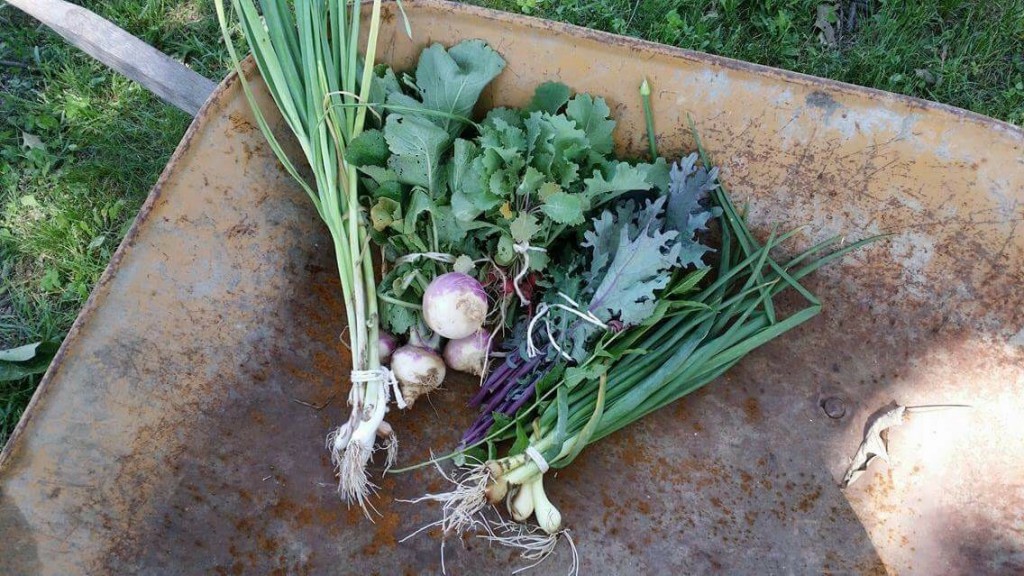
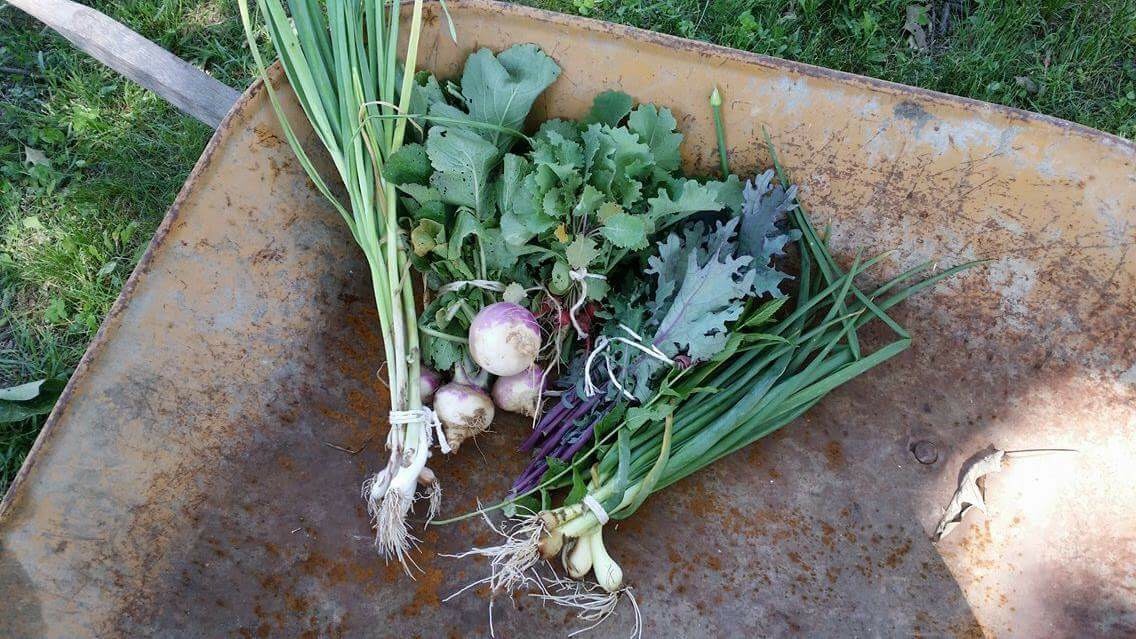
Left to right: baby garlic, turnips with greens, baby kale and radishes, Russian red heirloom kale, spearmint, spring onions. Your second CSA delivery has been dropped off! This week you’ve got turnips and turnip greens, a different variety of kale, spring onions, baby garlic, baby kale, and radishes.
- Baby garlic: You can use both the white and finely-chopped green portions of the garlic in cooking at this stage. It has a milder flavor than mature storage garlic, so feel free to add a little extra. For a special treat that only works with young, green garlic, try a green garlic pesto!
- Turnips with greens: Both the turnips and their greens can be used in cooking. Delicious in soups, sauted, or roasted, turnips are one of our favorites.
- Baby kale: Bundled with the radishes, this baby kale is tender and delicious as a salad green. Since we left the roots on, you can opt to plant and water them if you’d like some of your own.
- Radishes: Try this baby kale and radish salad option for a springtime treat.
- Russian red heirloom kale: This is one of our favorite varieties… light and sweet, it’s delicious as a salad green. It also makes incredible kale chips–heat oven to 35o degrees, wash kale and break or cut out any large stems, then tear into bite sized pieces. Use parchment paper on a cookie sheet if you have it, or just drizzle a little oil before you spread the kale flat across the surface. Drizzle a little oil over the leaves, then sprinkle with sea salt. Bake until the edges are slightly browned and the leaves begin to crisp, about 10 – 15 minutes.
- Spearmint: Makes a delicious tea or addition to lemonade, but we think it’s really good in salads, too. Try this cranberry bean salad with basil, mint, and feta cheese.
- Spring onions: The light, green flavor of these little delicacies is good raw in onions or sauteed with the young garlic as a basis for stir fries or cooked greens.
Hit us up with questions and comments–or pictures of your CSA dinners–here on the blog or on our Facebook page. For more recipe ideas, you can also look over last week’s blog again. See you again next week!
-
Spring CSA Profile: Lacinato Kale
This year we are trying out several new additions to the Spring CSA, including this delicious kale variety. Lacinato Kale is also known as black kale, Tuscan kale, cavolo nero, or dinosaur kale. It was one of the plants grown for Thomas Jefferson in the vegetable gardens at Monticello, making it one of the oldest plant varieties in our garden this year. It is also grown in Italy, and is a traditional ingredient in the Tuscan soup ribollita.

Lacinato kale growing for 2016 In the garden, lacinato kale can grow up to three feet tall. The leaves are bumpy (like dinosaur skin–hence the name dinosaur kale), and are usually harvested from the bottom up over the course of the growing season. As an heirloom variety, it thrives without the use of modern industrial fertilizers and pesticides. When you cook it, the bumps in the leaves help to hold pan juices, giving you bursts of flavor with each bite.
Lacinato kale has a flavor that is slightly more delicate than its curly or Russian cousins. You can use it in soup like ribollita (literally: reboiled), or you can eat it grilled, boiled, stuffed, roasted (mmmm… kale chips!) or–our favorite–partly blanched and sauteed with garlic, red pepper, and olive oil. It is gentle enough to eat raw in a salad, but holds its own even a lasagna or casserole.
This is one that you will probably not see at your local supermarket, and that you may not see from other farms around Memphis. In April and May when the baby green garlic and kale are both coming in–look out! You might get so spoiled that supermarket food just won’t do. If you haven’t signed up for the Spring CSA yet, check it out and get in before we run out of space!
-
CSA Week 3: Spring is in Swing
Spring is in full effect now that we are (knock on wood!) out of the cycle of endless rain. This week’s box resembles the first two, but with some new additions; read on!

Clockwise from top: Kale (2 kinds), cilantro, spearmint, garlic scapes, curly-leaf mustard, green-leaf lettuce. Spring onions and garlic in the center. Red Russian Kale and Giant Green Kale: OK; more kale. We were skeptics at first, years ago, but we are still finding new things to do. Most recent:
Grilled Kale
1 large bunch of kale
1/4 cup olive oil
1 to 6 cloves of garlic, minced (depending on your love of garlic)
2 tbsp balsamic vinegar
Salt and pepper to tasteMix last four ingredients in a bowl. Wash the kale, dry it, and toss it with the oil/garlic/vinegar mix.
Place the kale in a single layer on a medium-hot grill (about 350 deg. F). When it starts to seem crisp (about 2-3 minutes) use tongs to turn the kale. Grill one more minute, then remove to a stack on a plate. Serve alone or with other dishes.
Curly green mustard greens: If you love mustard, you can use this in a salad. We prefer it cooked–either in the traditional “southern style” with pork fat or, more often, wilted in a pan with garlic and olive oil. There is a theme here–garlic and olive oil are good accompaniments to veggies.
Cilantro: Some of you love it. Some of you hate it. If you never want to see it again (some people REALLY hate it) let us know. Bonus points if you guess what goes great with cilantro (hint: it rhymes with “car-lick.”)
Lettuce: This is black-seeded Simpson leaf lettuce; wash it well, use it like other lettuce. Ever had a wilted lettuce salad? Just barely sear it in a hot pan–then serve as usual for a salad.
Green onions: red, yellow, and/or white. We have an assortment of colors; usually in the store you only see baby spring onions in white. The different colors have slightly different flavors (really–try it).
Garlic: Softneck “Teenage” garlic. We’ve been sending you juvenile garlic; this week the garlic is a little further along–almost but not completely full-grown–so we are calling it “teenage” garlic. Like its namesake, it is stronger but hasn’t developed all of its adult character yet. Don’t try to store it for more than a couple of weeks.
“Tomatoes and oregano make it Italian; wine and tarragon make it French. Sour cream makes it Russian; lemon and cinnamon make it Greek. Soy sauce makes it Chinese; garlic makes it good.” ~ Alice May Brock, American author, b. 1941
Garlic scapes: You won’t find these at most super markets; every garlic plant doesn’t make a scape, but those that do make only one each, and the scapes are only around for 1-2 weeks. Try these sauteed in butter or olive oil, tossed with the pasta (or spaghetti squash) of your choice. Throw in some pine nuts and you have an amazing meal.
Spearmint: You can actually plant this and it will probably grow–feel free! Give the gift of mint! Use in tea, or make candied mint leaves: wash the leaves, brush them with a 50:50::egg whites:water mix, dip them in sugar, then arrange them in a single layer on a cookie sheet or drying rack. Let them dry for 24 hours (you can rush this in a Very Slightly Warm oven (~175 degrees F). These keep for a day or so in a jar at room temperature.
-
Seed Swap 2015 Guidelines!
Our Seed Swap is coming up on Saturday March 28. To help things run smoothly, here are some guidelines for swappers:
- Keep it simple! Have Fun!
- Bring a folding table and chair(s) if you have seeds to swap. No charge for table setup.
- Package seeds in small envelopes or bags.
- Mark seed packs with variety name, year collected/purchased.
- Be prepared to answer seed questions
- Swap! Seeds for seeds!
- If someone doesn’t have seeds to swap, sell or give away seeds as you choose. We will be charging $0.25/small pack (4 for a dollar) for seeds for people who don’t have seeds to swap. You set your own terms–bring your own change and keep track of your own money. Keep it simple! Have fun!
If you don’t have seeds, come anyway! We’ll have seeds and chili (we are asking for a donation for the chili). Our friends at Oleo Acres are having a propagation workshop at 1pm–right around the corner from us.