Apple blossoms on newly-planted trees, April 13, 2014
On Saturday, April 12, we had a visit from a large group of volunteers for apple tree planting. Our friend Robin works for St. Jude Children’s Research Hospital where she manages immigration services; she organized the volunteers and the whole tree planting day. The volunteers included friends as well as researchers from over 20 different countries–all of them came to plant apple trees, and many of them brought their families.
“An acre of orchard each season fixes about 20 tons of CO2 from the air, releases 15 tons of oxygen, and provides over 5 billion BTU’s of cooling power.” (Lakso, 2010)
All together, more than 50 people sponsored trees, and we now have an orchard of 50 apple trees! We purchased the trees from The Stockyard nursery in Arlington–they worked with us on the price, and the trees were all healthy. Now, nearly two weeks later, all 50 trees are still alive and well. The trees are red and golden delicious, fuji, McIntosh, and Anna, and so they are variously suited for pies, eating fresh, and cider. With some tender loving care and cooperative weather, we may have a few apples as soon as this year, and many, many more in years to come.
We have dreamed of adding more fruit trees for years, and then this gift came to us unexpectedly. A huge thank you to everyone who helped! Look for photos as the seasons progress!
Can you believe we’re nearing the end of our spring CSA? One week left! We’ve opened the summer session to current members, and we’ll open unclaimed shares for the general public next Friday.
We’ll start up the six-week summer session after a hiatus to let our summertime veggies mature. We’ll be in touch about dates as the time approaches, but we’ll continue to have Saturday pick-ups at the Quaker Meeting House on the corner of Prescott and Walnut Grove for the duration of the summer.
In the meantime, you have a beautiful box this week for your munching pleasure. Check it out:
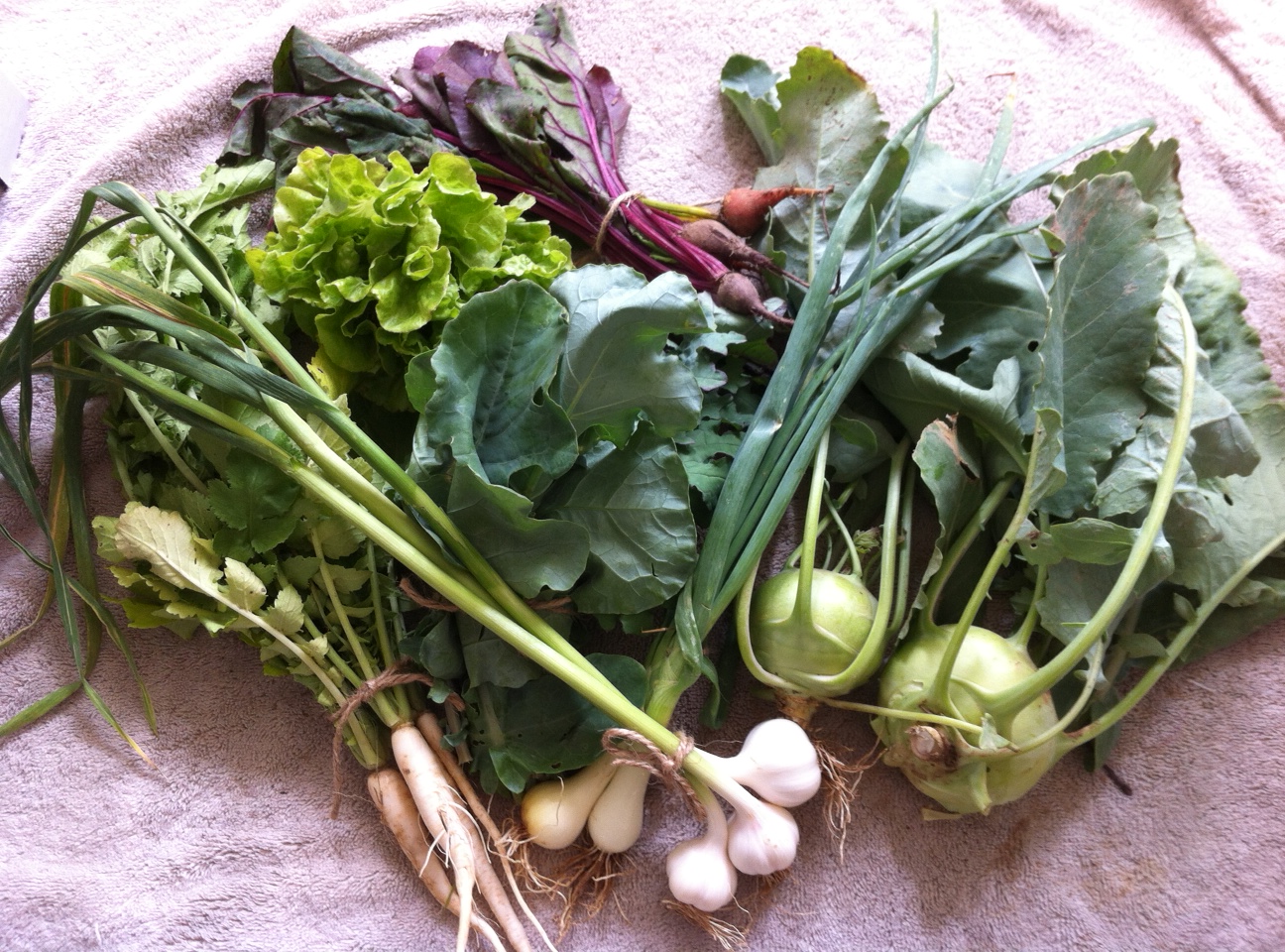
Clockwise from top: mixed beets, kohlrabi, garlic, onions, Japanese minowase daikon, Tom Thumb lettuce, mixed kale and broccoli greens.
Beets: This time, it’s a mix of garden-variety red beets and hard-to-grow, sweet and succulent golden beets! We’re proud of ourselves for coaxing them into growing up for us this year. Our test batch has been successful, so you can expect a larger crop next year if all goes smoothly. Roast both varieties together for a roasted beet salad with a bright flavor.
Kohlrabi: We’re willing to bet this will be a new one for some of you. The fine, crisp, almost peppery flavor of fresh kohlrabi is one of a kind. Coarsely chop the fleshy, bulb-shaped part (which actually grows above the ground) into a salad, saute the chopped bulb in olive oil and then add the greens, or try this delicious recipe for Kohlrabi Puree. Enjoy!
Garlic: This is likely to be our last week for fresh green garlic; we’ll be harvesting mature cloves to hang and cure in the coming week or so. It’s a seasonal delicacy that we both adore and our garlic harvest each year always has a bittersweet tinge to it. Spring garlic will be back next year!
Onions: Our spring onions are also getting larger and starting to bulb up nicely. We’ll see how large they grow if we leave them be for a few weeks; with luck, their larger selves will be gracing your boxes starting in July.
Daikon: It looks like a white carrot, but tastes like a radish! Japanese daikon is a relative of the common radish. Some varieties can grow to be longer than your arm. By those standards, these are just babies, but they have an excellent taste (and they’re easier to fit in the box!). Try this seasonal spring stew with baby daikon, or use them anywhere you’d use a radish.
Tom Thumb Lettuce: After all my excitement over baby lettuce heads, I think these may be as close to a real “head” as we see this year. More a butter leaf than a butter head, these are nevertheless crisp and sweet, with just a hint of richer summer flavor creeping in. Heirloom heads are always looser than the iceberg-style lettuce we see in the grocery store. For this season and this year’s weather, I’m just grateful to have happy, yummy, disease-free lettuce this late into the year.
Mixed Greens: Kale and broccoli greens are delicious when cooked together using any favorite family recipe for collards or mustard greens. Remove the stems in the broccoli greens (and the kale if desired). A little vinegar, a little spice, some salt and pepper, and some of the garlic and onions will give them an excellent flavor. Add a little water, cover, and simmer over low to medium heat until they’re cooked to taste–we like them cooked through, but still a little crunchy, anywhere from 5 to 20 minutes according to the batch.
The wet weather continues, though the temperatures are finally starting to rise. We never thought we’d be happy to see 80 and 90-degree afternoons, but the plants are loving it. The beets have really taken off, the spring greens are flagging, and summer goodies like Swiss Chard are starting to come on. In this week’s box you have:
Roughly clockwise from top: Green onions, kale, garlic scapes, radishes, young Tom Thumb lettuce, beets, romaine and arugula, swiss chard, and mixed herbs (rosemary, sage, and lavender).
Green Onions: You’ve been able to watch these little guys mature from week to week and, we hope, have by now discovered all sorts of delectable ways to work them into your meals. If you need a little inspiration (or want to use them as a long-lasting pantry staple), Emily over at Organic Authority has some excellent ideas for green onions.
Kale: Ready to move beyond kale chips? This versatile green is awesome in everything from frittatas to casserole to mashed potatoes. For some new ideas, check out Local Harvest’s “Kale Recipes–17 Different Ideas!” posted by Maplewood Organics up in Vermont. Some people recommend boiling kale before sauteing to make it extra-tender, or “massaging” it before use in a raw salad. Personally, we think this particular Russian Red variety is delicate and succulent enough just as it is–rinse and go!
Garlic Scapes: Wondering what do do with those mysterious green curlicues? Scapes are a secondary method of reproduction for some heirloom garlic varieties. These come from our signature Asian Tempest garlic and are basically a scallion that tastes like a bright, spicy garlic treat. Margo over at Greenling DFW posted one of my favorite-ever posts on using garlic scapes. If you’r a canner, pickle them and use them all year long. Meat lover? Wrap ’em in bacon! Love to eat raw? They’re perfect as-is on a salad. Scapes are one of those things that will work for everyone. And if you just don’t like garlic, put them in water and wait for them to bloom!
Radishes: The funky spring weather has these coming in a few at a time–one will be massive, and the one beside it just barely starting to bulb up. Enjoy these little tidbits on a salad or (if you drink alcohol) in that classic radish martini we mentioned back in Week 2. Want to give someone a laugh with their drink? Try this.
Tom Thumb Lettuce: This heirloom variety is a miniature butterhead with a creamy taste. I’ve left it on its roots, so it may last an extra day or two if you put it in water. These guys are growing so quickly I’m thinning almost every week. They’re delicious when young, but I can’t wait to see the mature miniature head. We get a kick out of growing new varieties out here. Hmmm… Should I be worried that I geek out over vegetables?
Beets: The beets are finally getting big! Roast the bulb in the oven with a little salt, pepper, and olive oil, either in a pan or covered in tinfoil. Then have at it–they’re great tossed into a stir fry; on a salad; mixed with quinoa, their cooked greens, and balsamic vinegar; or alone as a side dish.
Mixed Salad Greens: I love arugula–just in small doses. Mix it with the romaine and Tom Thumb (and even the raw kale or chard, if you like…), top it with radishes, green onion tops, scapes, and roasted beets–this week’s box will give you some of the best salad flavors spring has to offer!
Swiss Chard: LuxeEpicure calls swiss chard the “peacock of dark, leafy greens.” With red, pink, yellow, orange, and green veining big rich leaves, chard is delicious stir fried, in pastas and casseroles, or as a side dish by itself. Chop the stems and tear or cut the leaves into smaller pieces; cook the stems first since they take a bit longer and then add the greens–or just eat the greens raw in salads. You can even use the whole leaf to wrap tamales!
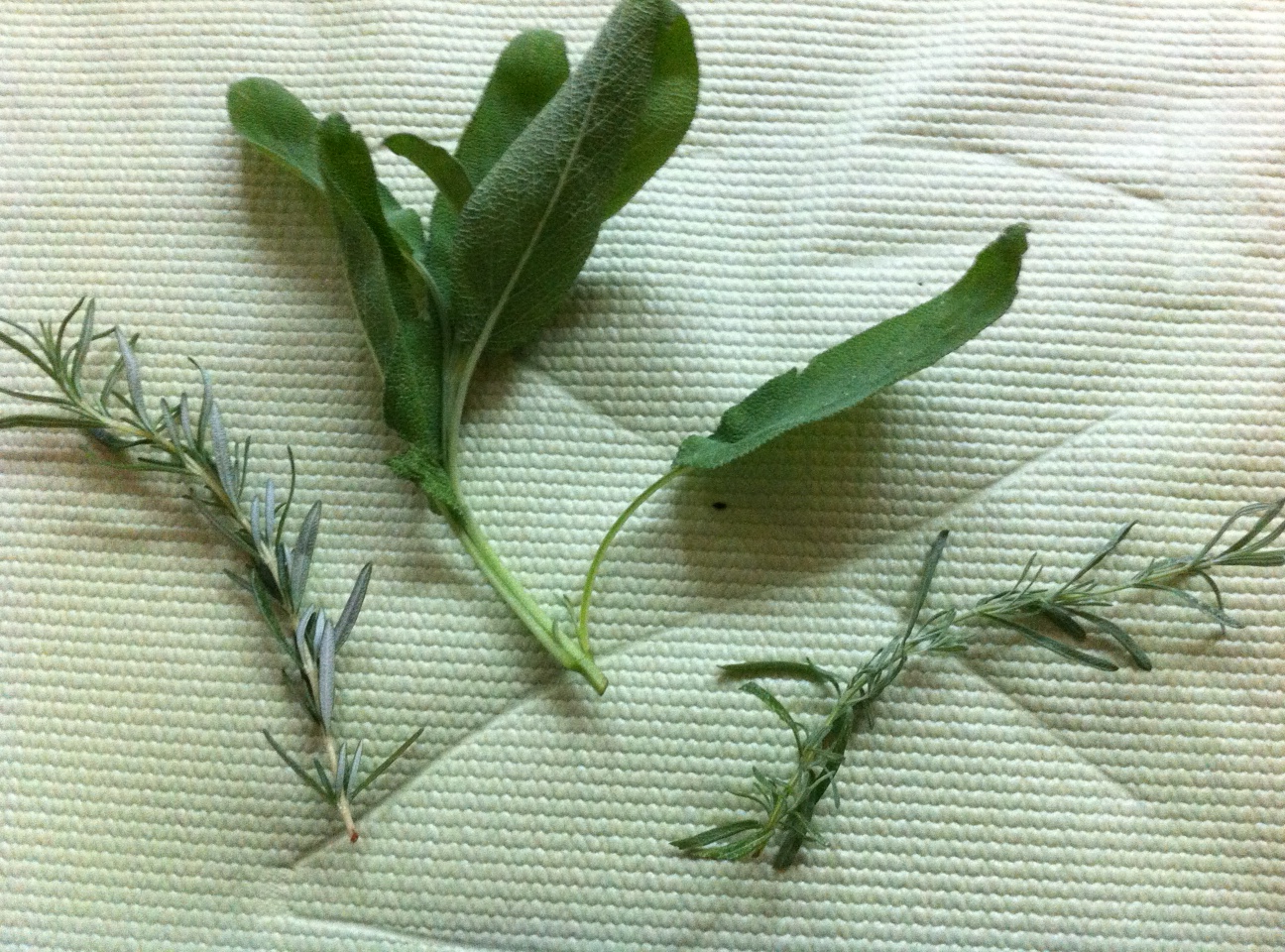
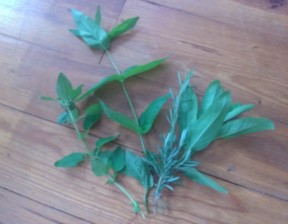
Mixed Herbs: See below… rosemary is deeper green, woodier, and generally sturdier than lavender–and the smells are unique. Sage is the broader-leafed green in the middle. All are excellent for cooking. I like a little sage in my eggs, a little lavender in the water I use to boil fresh green beans, and lots of rosemary with my pork, potatoes, or carrots.
Left to Right: Rosemary, Sage, and Lavender
Summer Plans
We’re hoping to have a “Farm Friends” cookout later in the summer for everyone who has participated in the CSA over the last two years. We’d like to do it in July or August–if you’ve been involved in the CSA and there are any dates that particularly suit (or don’t)… let us know!
We’ll also be opening up sales for the Summer CSA to our current customers at the beginning of next week (June 3) and to the general public the following week (June 10). Summer session should start by mid-July, though the dates may be variable due to the late start and cool, wet temperatures we’ve had so far. Let us know if you want to join the ever-growing circle of friends who pick up our boxes each week. We love what we do, and we’re ready to grow!
Thanks to Our Volunteers!
We had another volunteer day today–and despite the adverse weather we had one lone soul brave the elements to help us out. Thanks to Trevor, who helped us organize the tools in the shop while rain tapped a rhythm on the tin roof and our four-year-old “dusted tools” while getting dusty herself.
The veggie boxes are out to our “Farm Friends,” the animals are secure against the weather, and the shop’s tool room looks better than it has in years. Time for a well-earned rest and–if the weather holds–a cookout with some friends. We’ll raise a radish martini to all of you who keep us going.
I told the new apprentice we were having lamb’s quarters for dinner.
“I won’t have any. I’m a vegetarian,” she replied.
With a smile, I corrected myself. “Some people call it fat hen.”
“I don’t eat chicken either,” she responded with a frown.
“It’s also called goosefoot,” I countered, suppressing a grin.
“Not goose, not even the feet, do I eat,” she said with force.
And I agreed, “Pigweed is a more common name for it.”
“No matter what kind of animal it is, I am NOT going to eat it,” she stated firmly, her eyes shining with fervor and unshed tears.
I confessed, now openly laughing. “It’s a weed. A plant. A cooked green!”
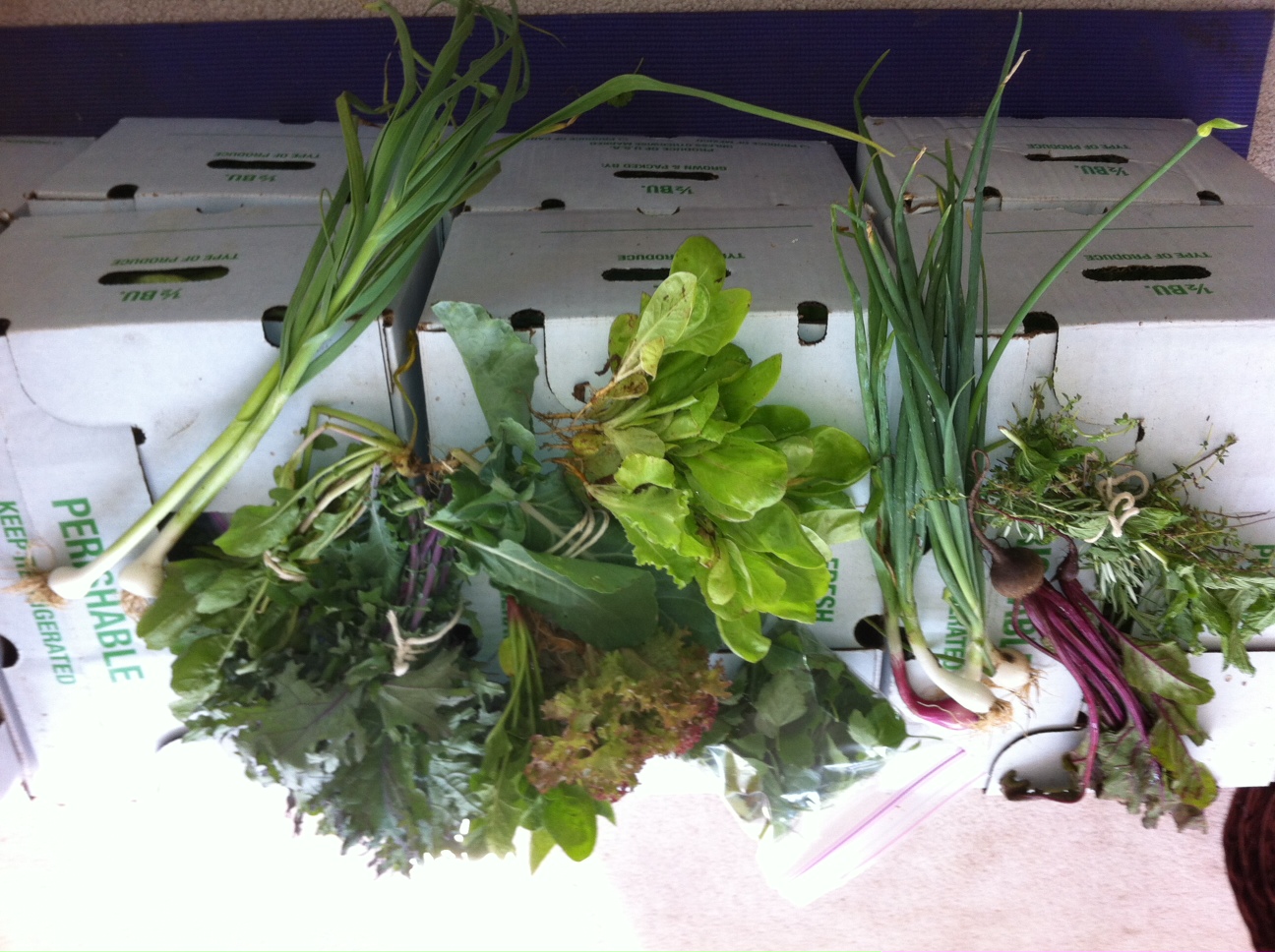
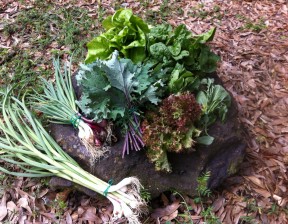
In this weeks box: Mixed herbs (thyme, mint, rosemary), beets, spring onions, bibb lettuce, lollo rossa lettuce, lamb’s quarters (in the small bag), spinach, broccoli greens, kale, arugula, spring garlic
CSA Week 3: What is in the box?
Kale: This is a spring favorite, but it will come to an end eventually as hot weather hits. Enjoy while you can. If you want a fresh adventure, try this chilled kale and apple soup. We haven’t tried it, but I bet this would be great with a dollop of sour cream and a sprig of fresh mint…
Spinach: Say farewell to our little friend. This looks like the end of the spinach. Luckly, her wild cousin has made an appearance–see lamb’s quarters below!
Lamb’s Quarters: Goosefoot, fat hen, whatever you call it–this is a delicious spinach cousin; use it where you would use any other green. Like spinach, be sure you rinse it well, since it tends to accumulate garden dust. If you dig around the Interwebs, you can find lots of ideas–but here is a starting point. In Mexico, Lamb’s Quarters is known as quelites (as are some other greens). Let us know what you think–we have a TON of this, but harvesting the small leaves is time consuming.
Beets: Beet greens are delicious this time of year, when they’re large but still succulent. Wilt them with other greens in a stir fry or saute. Beets are one of our favorite vegetables. You can roast them and put them a salad–but sometimes I like to wash them and eat them raw.
Arugula: Wham! That’s flavor. Arugula picks up spice as it gets closer to bolting, and ours definitely has a zing. It is a shame that tomatoes don’t really come in until summer, because arugula and tomato mix well. (Hint: try a BLT, but with lots of arugula instead of lettuce and with added avocado. Bacon, Arugula, Tomato, Mayo, Avocado, and a pinch of sea salt (NaCN). The BATMAN sandwich is born!)
Green Onions: Do you notice a trend? Our baby onions are growing up. Yes, we still remember when these were just little sprouts. Before long, they will be all grown up.
Spring Garlic: What else can we say about Garlic? This is one of our specialties, a favorite of the Farm. We put it in almost everything; use it like a green onion, or use it like garlic. One of our heroes, Alice Waters, has this recipe for green garlic spaghetti. Wow. Just… wow.
Broccoli and Cauliflower Greens: We served these up last week, and they are back; the chard needs a break for a week, and the strange spring weather is not helping our broccoli to form heads. We had broccoli greens in a crustless quiche this morning, along with baby garlic and three cheeses, and it was amazing. This one is an original, not a link:
Crustless Quiche with ???
1/3 cup cooked quinoa 4 eggs, beaten 1/3 cup milk 1/3 cup feta cheese 1/3 cup parmesan 1/3 cup cheddar Salt and Pepper to taste
Preheat the oven to 350 degrees. Butter a glass pie pan. Mix all ingredients, pour into pan, bake for 45 minutes. We actually baked it for 30 minutes, then turned off the oven and came back to the house an hour later, and it was fine. This is a forgiving recipe–play with it!
Lollo Rosa and Bibb Lettuce: “Looks like we’re having salad again…” WAIT! Not so fast! Sure, you can use these lettuces for a salad, but why not make something like these Vietnamese spicy shrimp wraps (you can do this with tofu, too)? Make the filling, put the lettuce on a plate, and let your family and/or guests fill each leaf on their own. Be sure not to forget the lime dipping sauce (see link above).
In other news…
So, a few months back we mentioned on the FaceBook that we might try to start selling coffee through the farm. Turns out, almost all of the coffee we can get is sold through one of the big coffee brokerages, and we really wanted to develop a relationship with a particular farmer, someone who had stories we could share about specific people and specific coffee. We don’t have a deal yet, but we may have a lead! We met someone who sells coffee from a farm in Honduras. As of now this is just a teaser, but we will let you know how things go!
Ellie here, with your CSA share list for Week 2. Things went a bit more smoothly this week than last!
Thinning
This week, most of our beds needed to be thinned. When we plant, we plant more seed than we think we’ll need, in case some doesn’t germinate. Then, as our veggies mature, we pull some to make room for the others to grow big and strong. It’s a customary practice among farmers and gardeners to insure a good harvest.
A Taste of Spring…
The thing is, the plants we pull are just as delicious as the ones we allow to grow to maturity. Waste not, want not! So this week, I’m giving all our CSA shareholders a little taste of spring. We’ve included a wide variety of salad greens and cooking greens, as well as a few treats that won’t be mature for a couple more weeks–like the beets (which are good for their greens now, though the beets themselves are still teeny).
In your box, you’ll find:
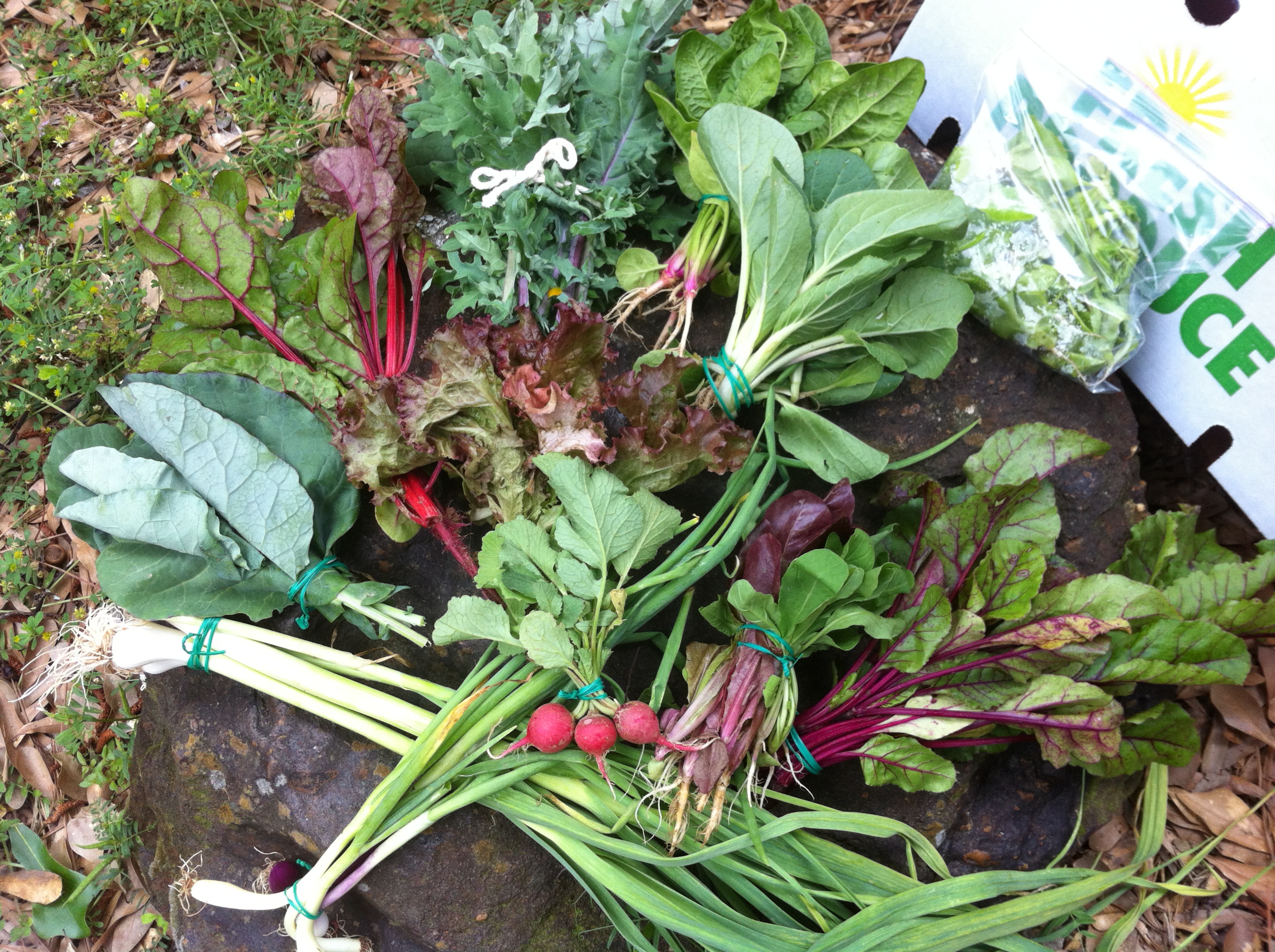
Clockwise from top: Kale (tied with white string), spinach, Chinese pac choi (bok choy), mixed baby lettuces (in plastic bag), baby beets, red romaine lettuce and green arugula bundled together, radishes, green onions, spring garlic, mixed broccoli and cauliflower greens, and swiss chard. Lollo rosa red-tipped lettuce in the center.
For a closer look:
Kale: Last week, a couple of our shareholders reported a new love of kale chips! Check out last week’s blog for the recipe. They’re also excellent in salads or as a cooked green.
Spinach: These little guys are starting to bolt, so we won’t have them around for much longer. As the life cycle of most green leafy vegetables plays out, they go from growing leafy greens outward to sprouting an upward central stalk that flowers and eventually bears seed. Once that stalk appears the plant has “bolted” and the leaves usually taste bitter. Bolting usually occurs for early spring greens not long after temperatures climb into the hot, humid summertime range. Enjoy them while you can–we may have one or two more weeks before true spinach is out for the summer. Keep an eye out for “Malabar spinach” later in the summer for another treat.
Pac Choi: The pac choi is also starting to bolt, though it’s not as large as we would have hoped. The wet, cool conditions transitioning suddenly into sunny heat have our pac choi feeling a little confused. Still, it’s particularly succulent when small. Try this Food Network recipe for stir-fried bok choy with our green garlic and ginger to bring out the delicate springtime flavors.
Mixed Baby Lettuces: Pinch off the roots, float the leaves in water to rinse, and toss into your favorite salad. These green lettuces have a punch of flavor when mature but are still sweet and fairly delicate this young. One is a “Big Boston” loose-leaf lettuce and the other an heirloom heading variety called “Tom Thumb” that produces tiny heads. We can’t wait to see the mature version!
Baby Beets: Beet greens are delicious this time of year, when they’re large but still succulent. Wilt them with other greens in a stir fry or saute. Or chop/cube the baby beets into a stir fry with other veggies and then toss in the greens a few minutes before the stir fry is done.
Romaine and Arugula: These classic spring salad greens pack a rich, almost spicy flavor that takes your lunchtime salad to a new level. We think they’re excellent as a bed under grilled chicken, but you’ll find your own favorite signature salad.
Green Onions: Usually, we try to leave the protective outer coating on our onions (along with the roots) to help them stay fresher longer. There’s been so much wet weather lately that the usually papery outer shells were actually waterlogged, so I’ve stripped them back to reveal the healthy green onion beneath. Enjoy!
Spring Garlic: We’ve added a little bunch of spring garlic to this week’s bounty, but we don’t want to overload you after the big batch last week. Expect at least a little garlic almost every week–it’s an Oak Hill specialty and a staple of a healthy diet. Almost anything tastes better when it’s cooked with garlic and onions!
Radishes: Of course you can use these in a salad, but why not change it up? Radish greens fit right in in a potato soup and give a delicate, bright flavor. The wet conditions we’ve had have caused some of them to split–but eat them while they’re fresh, and there’s no effect on flavor or consistency. If you drink alcohol, try this springtime radish martini!
Broccoli and Cauliflower Greens: Did you know that broccoli (and cauliflower) greens are edible, delicious, and even more nutritious than the parts we usually see in stores? Probably not… we don’t get the greens in stores often–another benefit of your CSA membership! They can be hard to tell apart, but the broccoli leaves are a little smaller and lighter green, while the cauliflower are a deep green on a broad, rounded leaf. Delicious raw or cooked like collards, they’re a nutritive powerhouse that tastes like broccoli–without the little green bits to stick between your teeth!
Swiss Chard: This beautiful green is a heat-tolerant work horse that seems to love West TN conditions. It’s delicious and delicate in this small springtime state, but it’ll grow massive and robust as the weeks pass. Organic growers love it for its weed tolerance and longevity. We’ll keep it coming! While it’s young and fresh, let those simple flavors shine with this easy recipe for chard with balsamic vinegar and garlic.
Lollo Rosa Lettuce: This lettuce is a nutritional powerhouse, packed with 100 times the antioxidant power of common green lettuces and rich in folate, iron, and vitamins A and C. It’s slow to bolt, has a rich nutty flavor, and boasts a beautiful color combination that’s excellent for garnishing as well. We think it’s gorgeous in a salad with our red romaine against a background of rich green spinach and light, fresh baby greens.
In other news…
We have baby pigs!
There’s your cute baby picture update of the week from your friendly neighborhood farmers :).
Time to get to bed… busy day tomorrow. We’re looking forward to a volunteer shift tomorrow morning–thanks to our CSA “Farm Friends” on the workshare program who are coming out to help us battle weeds. I’ll be in town delivering boxes; Ted will be be out here working hard with the volunteers. Sometimes we have to split our forces, but we always get it done in the end!
We had a rocky start to the day, but boxes are in are shareholders’ hands and everyone seemed happy with their shares! Every box smelled divine — green garlic and onions mingling with kale, fresh lettuces, and herbs. If you took home a box for your very own, here’s what you got:
Clockwise from top: Bibb lettuce, spinach, arugula, Lollo Rosa lettuce, garlic, onions, kale
Kale: This variety, Russian Red, has loved our wet weather and is taking off, so expect more in the coming weeks. Saute it in a pan or make one of our all-time favorites — Kale chips! Guilt-free snack food at its finest, and so easy to make!
Bibb Lettuce: This loose head lettuce has a buttery consistency and makes a lovely salad.
Lollo Rosa Lettuce: This leaf lettuce has a sharper flavor and adds texture — great for holding on to salad dressings.
Green Garlic: Young garlic has a delicious mild flavor when you use it in a saute. Use the whole stem in a soup or broth, or use the stiff neck like you would a leek. Green garlic doesn’t last like cured, mature garlic will; try to use it in the next week or so. If it starts to go brown, make your own garlic powder!
Spring Onions: Use like a regular onion. Chop them up in sautes and casseroles, or use them in salads. You can also use the stem like a scallion — chop it up and use for garnish or in soups. The bunch in your box contains a mix of red, white, and yellow green onions.
Mixed Herbs: Rosemary, oregano, mountain mint, and sage. Use together or separately… Boil green beans in water with sage and mountain mint, use rosemary with potatoes or pork and oregano in any Italian food or salad dressing. If you’re feeling adventurous, put your sprig into moist soil and see if it roots — before you know it, you’ll be growing your own herbs on your window sill!
Arugula: This lovely spring green has a bracing bite. Use a little in your salad for a big kick.
Spinach: Rich, green spinach has been happier in the wet cool weather than it usually is in the Memphis heat — enjoy! Cook it in a saute pan and serve as a wilted green or use it fresh in a salad… we love it under salmon or tuna with a corn salsa over the top.
Left to right: oregano, mountain mint, rosemary, and sage.
Once Upon a Time…
…Not so long ago and very, very close to home, we had a workshare volunteer (Bobbie Ann) help us harvest and wash a ton of fresh greens. We tucked them snugly into bed in the new CSA-only refrigerator for the night, thinking that we had a leg up on the Saturday delivery. Imagine our alarm when, the next day (Saturday) all those greens were stiff and frozen. Lesson learned! Our fairy tale first pickup may have turned out to be a parable, but it still had a happy ending. Our loss is your gain–we bring you vegetables that are fresher than even we expected! Luckily we overplanted by enough that reharvesting shouldn’t cut into future harvests. If you are a geek about such things and wonder just how we schedule planting and harvesting, you might look at these spreadsheets from North Carolina State University that we adapted to develop our own schedule.
Wash those veggies!
Remember, even though we don’t use chemical fertilizers or pesticides, these veggies are fresh from the ground–they may come with some rich soil still attached. We give everything a rinse in clear, cool water before it goes into your boxes, but we recommend that you wash again before you cook or eat. Especially in the wet weather we’ve had, dirt tends to cling. For your eating pleasure, wash them in cool water to avoid grit.
Don’t be a hater…
Is there a bug on your greens? Cool. That’s how plants naturally grow in a healthy environment that encourages a total living ecosystem: with some bugs here and there. Any hitchhikers should come off in the wash.
Let us know how it goes!
If you have a great recipe to share with the CSA community, you can post it here or on our page on The Facebook.
This week’s CSA share doesn’t come with a photo… but head over to Mid South Moma’s blog to see her photos. She’s one of our new shareholders this summer!
We’re still struggling to get back on track after our weeks without rain, so our boxes aren’t quite as full as we’d like. If the trend continues, we’ll add a seventh week to the summer series to make sure that our customers get their money’s worth.
Here’s what our shareholders received this week:
Tomatoes: We have three tomato varieties this year: Cherokee Purple, Brandywine, and Mortgage Lifters. The ones in your box this week are a mix of Mortgage Lifters and Brandywines. Some of the Mortgage Lifters are ours, some were supplemented by our friends at Oleo Acres.
Hot Peppers: These are a mix of jalapenos (the red ones this week are the mature version of the green jalapenos you saw last week–with more kick, too!) and cayenne peppers. Both can be dried in a food dehydrator, the oven, or the sun and saved for crushed red pepper, or added fresh to a variety of dishes.
Garlic: Our cured garlic should last into the winter months if you hang it in a cool, dry place. Use a clove at a time, or amp things up and create a dish that lets the flavor of our garlic sing for the GARMACY Festival Garlic Cookoff on August 25!
Basil: Hands down, our favorite thing to do with a bunch of basil is making pesto. To preserve whole fresh basil leaves without drying, try this recipe for freezing herbs in oil, and enjoy fresh basil all winter long.
Figs: Our fig trees seemed to love the spell of dry heat and are producing so. many. figs. They’re wonderful fresh, as a complement to pork, roasted with honey and served over ice cream, or even canned (whole, as preserves, or jellied).
Okra: This reliable summer favorite is coming along so prodigiously we literally have to harvest every day. You can almost watch them grow. Roast them, fry them, stick them in a stew… or freeze them. Cut them cross-wise or in long, green bean style strips, lay them out on a cookie sheet, and pop it in the freezer. Once the individual pieces are frozen, they can be consolidated into a freezer bag without resulting in a slimy mess.
Eggs: Even the chickens are on strike in the heat… egg production has gone down. We’ve given each of our CSA members six eggs in addition to the vegetable share to supplement our offerings this week.
Canned Goods: Your free gift this week is twofold–a jar of fig jelly and a half-size jelly jar of our famous fig preserves. Let us know what you think! We’ll have more for sale as long as the figs hold out!
Thanks to our shareholders for sticking with us during an unpredictable summer. We have more variety ripening on the vine within the next few weeks if the weather is with us. We’ll get by with a little help from our friends!